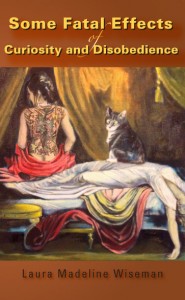
Lavender Ink releases Some Fatal Effects of Curiosity and Disobedience

My book Some Fatal Effects of Curiosity and Disobedience was released this spring from Lavender Ink. I thought I’d post an update about what’s been happening since it’s release. Some Fatal Effects of Curiosity and Disobedience is a campy, contemporary retelling of the Bluebeard myth, that charts the love of three sisters who each marry the same man upon the demise of the sister who preceded her. Bluebeard is usually framed as a story of blood and gore, but this telling focuses on the love each of his unfortunate wives felt, the first blush of romance and young marriage, the complicated turns of mature desire and the past we bring into our present affections.
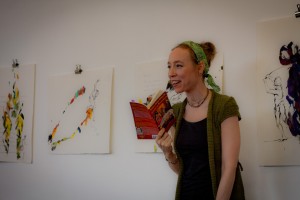
lmw_omaha1

I’ve given readings from my new book in West Virginia, Nebraska, Illinois, and elsewhere, including at the Nebraska Book Festival in April. There’s a YouTube playlist of poems from the book.

Recently, I had the opportunity to have a conversation with sister poet Sara Henning about her Lavender Ink title A Sweeter Water in The Sundress Blog. I was able to talk about reading and researching the bluebeard myth, as well as her own smart, lovely book.

My mother had a baby blue hardback edition of the Grimm fairy tales, one with gold embossed lettering on the cover and edge gilding. Sometimes at bedtime we were allowed to crawl into her queen-sized bed and she would read us a story from those pages of onion skin, those tiny words, under that soft glow of her bedside light. I’m not sure if she read the versions of the bluebeard story from Grimm to us, but it was a story I recognized later while I was working on my masters degree in women’s studies at the University of Arizona.

I also spoke with sibling poet Megan Burns about her Lavender Ink title Sound and Basin in Pank. I discussed the interconnectiveness of desire and violence within the bluebeard myth.

If fairy tales and myths are meant to be didactic, even if we no longer live in the time of their original construction, I wrote Some Fatal Effects of Curiosity and Disobedience because I was curious to know what it offered us today. I kept coming back to a line from Charles Dickens’ version: “But the fair twin loved him, and the dark twin hated him, so he chose the fair one.” I thought about hate and resentment and marriage and why we might stay with someone, sensing the threat of bodily harm towards us, even if that violence isn’t manifested until our murder. I also was working within the bluebeard frame and the ways in which each of the sisters may have been aware of plot—a meta-awareness of the larger story their small place fit into—much as any of us may reflect on our place in plot (e.g. marriage, American Dream, keeping up with Jones’, etc.) even as we may (or may not) think of them as story lines, narratives, fiction. The sister in “Self-Portrait” chose to desire a violent man. Or perhaps he chose her. Or perhaps, she was framed and so thus framed, was made to be what she became.
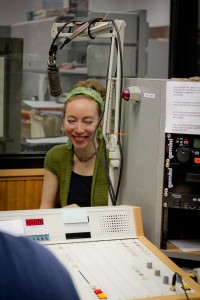
npr_interview2

I also talked about Some Fatal Effects of Curiosity and Disobedience on KIOS-FM, Omaha Public Radio and read from the book on air. Here are a few mp3s from that reading and more.

Fruits

Widower’s Insomnia

Our Sister Cared

The Blue Funeral
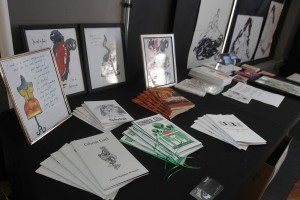
apollon-books-2

Right after the book’s release, I featured the cover artist Lauren Rindaldi about her gorgeous cover art. Here’s Lauren’s artist description of the piece:

Desire’s Conquest and Demise
The Nightmare, which depicts an incubus, a horse and a sleeping woman. In my painting, the incubus is replaced by my deceased cat. The woman takes a position believed to encourage nightmares, and the horse (or mare), in my piece, is replaced by another woman. It is meant to simultaneously show a woman dreaming and the contents of her dream or fantasy. This painting is part of my most recent series of works exploring ideas about the pursuit of fantasies resulting in deterioration, decay or even death.
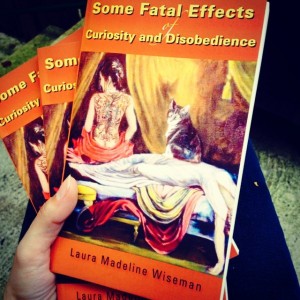
fatal effects in the hands of artist Lauren Rinaldi

Here’s some praise about my new book.

Some Fatal Effects of Curiosity and Disobedience is an ingenious narrative of poems that transposes the Bluebeard myth to our contemporary lives with a chilling authenticity. The juxtapositions of desire and danger, trust and betrayal, innocence and cunning all seem absolutely modern, as if they could be happening down the street or in our own lives, even as we recognize their ancient, terrible truths. Laura Madeline Wiseman’s command of the language and balance between irony and dead seriousness is pitch-perfect and this is a haunting book. - Ellen Bass


What happens when a woman dares to enter forbidden spaces? Tucked into legend, the poems in this collection shift from sensual to sexy and from enchanting to haunting, as they explore the question. Laura Madeline Wiseman is both poet and storyteller, deftly moving back and forth through time, weaving breathtaking parts into a heart-stopping whole. - Tania Rochelle


Predicated on the Bluebeard tale, Wiseman weaves a contemporary mythology that reaches more deeply and pervasively into the very human psychology and psychosis we name love. These poems traverse a dark storm of sexuality—the forbidden, the cruel, the guilty-pleasures. Lunacy and denial pulse mysteriously as mating ritual, as in these lines from “Solo Artist, Another Late Wife”: “…and she pretends for a moment / that this cheap condo is Carnegie Hall and his hands / that rain down on her are applause…” Control and conviction are knives bladed as sharply as the key to truth. Some Fatal Effects of Curiosity and Disobedience is erotic, disturbing, and utterly compelling. This collection, the stuff of nightmarish transformations, may cause you to see an altered face when you gaze in your day-lit mirror. - Lana Hechtman Ayers


Wiseman’s imagination is expansive, sultry, and wild. Some Fatal Effects of Curiosity and Disobedience is a masterpiece of antonyms. Wiseman’s speaker first appears to be a traditional woman: married, want of secrets, but curious and complex. Like many women, she wrestles with society’s fetters, which is easily identifiable and sympathetic. It is in this way she acts as a great literary heroine; the reader, perhaps lost themselves, roots for her to find her footing. Just as we think we have her understood, the book quickly transforms from a biography of a marriage into a lesson in the subversive. Wiseman’s speaker does reference work in the taboo. She struggles with the direction of her sexuality, fidelity, even marrying her late sister’s dangerous husband seems to be out of her control. She has simultaneous desires: to be dominant, to be taken, to be voyeur/watched, to be pursued/left alone, to be safe, to be killed. Ultimately, this book begs the question: how well can we ever know those closest to us? And perhaps more importantly, how well can we ever know ourselves? - Danielle Sellers


Drawing from Bluebeard and other renderings of misogynistic myth, Wiseman captures the universal experience of love skewed by an imbalance of power. Seduction, eroticism, betrayal, self-knowledge in the aftermath—it’s all here in this beautiful book, in fierce, aching lines chiseled with elegance and compression. - Rebecca Foust
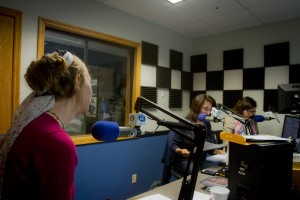
radio2

What’s next? I’ll be on the local radio on The Joy Factor next week.

Interview on The Joy Factor with Shelia Stratton
6:00-6:30 pm, June 24th, 2014
89.3, KZUM FM & HD (radio)
Lincoln, NE’s community radio
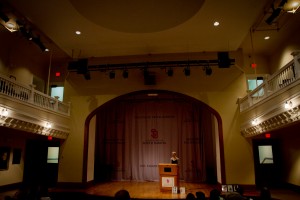
sd_4

I’ll also be reading from this book and more soon. I hope to see you there!

Reading in the Wit Rabbit Reading Series
with Lavender Ink Poets Sara Henning & Megan Burns
7 pm, Tuesday September 2, 2014
Quencher’s Saloon
2401 N. Western, Ave.
Chicago, IL

Reading in the Smoking Glue Gun‘s Sunchild Austin Summer Readings
with Christopher Klingbeil, Jerrod Bohn, Kendra Fortmeyer, & Kelly Luce
Sundown, Friday, September 26, 2014
SSG House, 2845 B San Gabriel St.
Austin, Texas

Poetry & Pints Reading
with Lavender Ink Poets Megan Burns & Sara Henning
8 pm, Sunday, November 16, 2014
Harmony Brewing Company
1551 Lake Drive Southeast
Grand Rapids, MI 49506
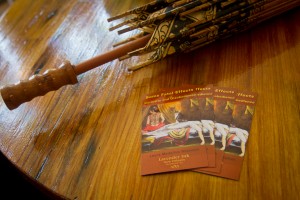
magnets

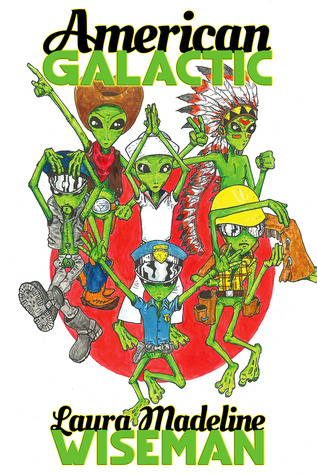
American Galactic is released

9full500
Hooray! My new full-length book of poems American Galactic has been released from Martian Lit Books. Opening with an epigraph from Charles Simic, “Lots of people around here have been taken for rides in UFOs, American Galactic (Martian Lit Books, 2014) explores the sci-fi realm of Martians, crop circles, abductions, and how the human race faces an extra-terrestrial invasion: “I don’t know/ what I’d do if Martians arrived at my door.” American Galactic charts the intergalactic tale right here at home. Find out about “The Left Boob of Largeness.” Learn “What do Martians Want.” Understand “Why not to Buy Martians Sundaes Topped with Cherries.” And ultimately enjoy these “Close Encounters of the Third Kind” in this bold new collection of sci-fi poetry.

American Galactic with Martian Lit Books 2

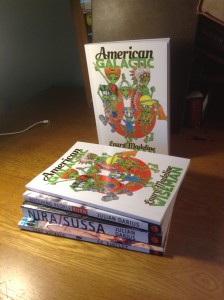
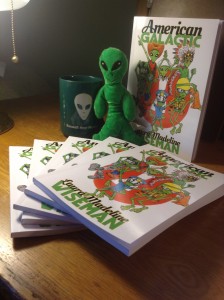
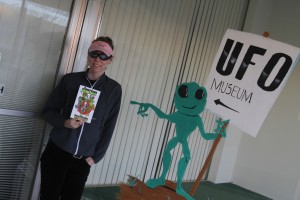
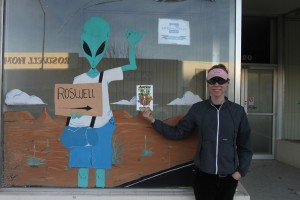
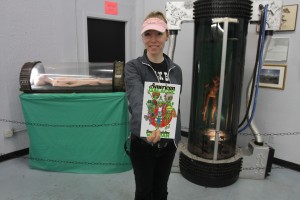
I just received my author’s copies. They look pretty fabulous with other Martian Lit Books. I had the opportunity to interview one of my sibling Martian Lit Books authors, C.S. DeWilt, for Martian Lit this month. American Galactic looks good next to the Martian items I purchased while in Roswell, New Mexico recently.

American Galactic with swag 2

And what are people saying?

“Warning: south of the train tracks, a Martian dream. Stranger still, habitable worlds abound. Wander through them, the lunar greenhouse full of NASA-planted lettuce, the fields of genetically modified soybeans, the tips to save your life. Like a Martian, ‘ooh and ahh at crescent moons, the meteor showers.’ Absorb this motion, before it vanishes. What’s staged and what’s real? What mechanism clears away panic and fear from a landscape, until it awaits pilgrims? The answers, or not-answers, are within the galaxies of American Galactic.
– Monica Wendel, author of Call it a Window and No Apocalypse

American Galactic near the UFO musuem

“Look out, the Martians have landed! And they’re having a poetic romp with Laura Madeline Wiseman. Her narrator opens the door ‘with a bowl of chocolate, suckers and quarters,’ and the little green creatures move right into her house, her garden, her outings, her community… even her mind. By the end of this quirky, imaginative, and well-researched collection, you’ll wonder whether we all indeed carry around our own Martians.”
– Ellaraine Lockie, author of Stroking David’s Leg and Coffee House Confessions

heading to rosewell with American Galactic

American Galactic is a reminder that good astronomers and great poets are driven by imagination. These interplanetary poems are rich with it, taking the reader on a trip to new, unexplored landscapes with heart and humor. Playfulness, curiosity and surprise infuse the poems, in which Laura Madeline Wiseman puts the reader right up front in the face of ‘the other,’ to confront a stranger, strangely familiar.”
– Sarah J. Sloat, author of Home Bodies and Inksuite

American Galactic inside the UFO museum

“The Martians have landed in American Galactic, and the more Wiseman reveals about those little green aliens and their odd habits, the more we learn about our own human nature. This collection is more fun than a Cold War sci-fi flick plus a bag of buttered popcorn.”
– Julie Kane, author of Rhythm and Booze and Paper Bullets

Learn more about American Galactic at Martian Lit Books. Follow American Galactic on facebook. American Galactic is available at Amazon. Read more about my fascination with Martians in my forthcoming interview in Hermeneutic Chaos Journal‘s author interview series Terpischore’s Atrium. Here’s a sneak peak.

A few years back, the state where I live was hit by several storms. For the months of April and May, we lost power several times, tornado sirens became a part of each week’s expected sounds, and surveying the damage of power lines draping swing sets and tree limbs split and fallen around my neighborhood became a common experience when I took my dog for a walk. For some reason that spring Martians walked into my poetry.

I also talked a bit about my Martian love in the Daily Does of Lit interview Three Question Series.

As a writer, I feel when characters walk into your work you are required to follow them around until they’re done with you. Thus, the Martians and I wandered around writing poems in the Sheldon Art Museum and the Nebraska State Historical Museum. We re-watched alien classics like Enemy Mine and Close Encounters of the Third Kind. We reread extraterrestrial books like The Martian Chronicles and did some general Martian research on UFO spotting, abduction accounts, and crash landings, like the famous one in Roswell, New Mexico.

Finally, there’s a goodreads giveaway of two signed copies of the book.

Goodreads Book Giveaway

American Galactic by Laura Madeline Wiseman

American Galactic

by Laura Madeline Wiseman

Giveaway ends August 28, 2014.

See the giveaway details
at Goodreads.

Enter to win

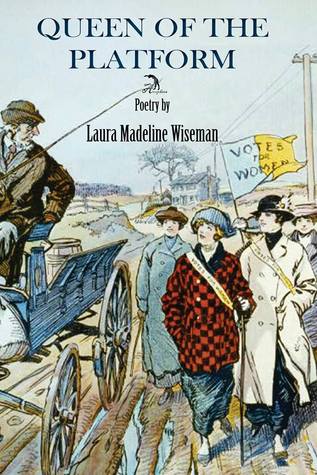
Matilda Fletcher Wiseman as Queen of the Platform

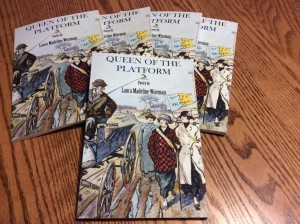
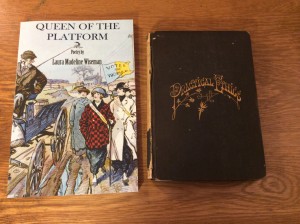
QUEEN OF THE PLATFORM first copies

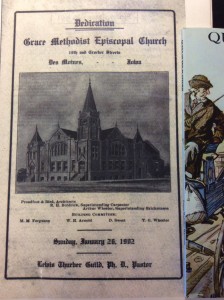
My dissertation that became the book Queen of the Platform has been out just over six months. Hooray! I thought it’s time to write an update about my second full-length collection of poetry published in December 2013 by Anaphora Literary Press. The poems in Queen of the Platform are based on the life of my great-great-great-grandmother, the nineteenth century lecturer, suffragist, and poet, Matilda Fletcher Wiseman (1842-1909). I first learned of Matilda when my father and grandparents suggested I look up my great-great-great-grandmother “who spoke at Chautauquas while her stepchildren sang and danced.” They didn’t know much about Matilda, but they did know a bit about her second husband, William Albert Wiseman, who started the Grace Methodist Church in Des Moines, Iowa.

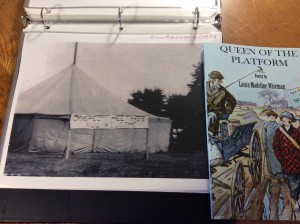
The tent church were William Albert Wiseman spoke.

(The tent church where William Albert Wiseman spoke.)

GM Church, Des Moines, IA 1902.

(GM Church, Des Moines, IA 1902.)

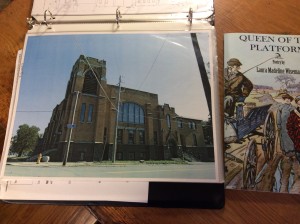
It started as a tent, became a wooden building, and then was rebuilt a few years later in brick. It still stands today on the corner of Crocker Street in Des Moines.

GM Church, Des Moines, IA 2009

(GM Church, Des Moines, IA 2009.)

So knowing these two small bits about Matilda - she was a lecturer and her second husband was a minister in Des Moines - I began talking to relatives who had interests in genealogical work, examining family artifacts and letters, and researching historical documents to find out who Matilda was, where she spoke, why she gave a lecture to over seven thousand in Indiana accompanied by what the newspapers called a “heart chart,” and why one of her popular talks and one of her published poems was entitled “The Heart of a Man.” One Wiseman cousin allowed me to look at a scrapbook Matilda kept during the first years of her lecture career.

One of the first pages in Matilda Fletcher Wiseman's scrapbook, 1869-1874.

(One of the first pages in Matilda Fletcher Wiseman’s scrapbook, 1869-1874.)

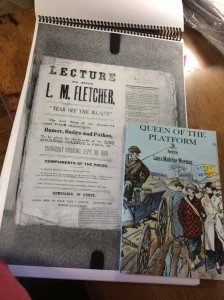
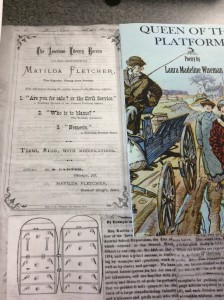
Some of what Matilda wrote has survived-some of her letters to the editors, poems in full or excerpted—however much of Matilda’s work remains in fragments as quoted in historic newspapers, and even more remains in announcements only, such as the lecture “Are You for Sale?”

The American Literary Bureau's renouncement for Matilda Fletcher, "The Popular Young Iowa Poetess" early 1880s

(The American Literary Bureau’s announcement for Matilda Fletcher, “The Popular Young Iowa Poetess” early 1870s)

A photograph of Matilda has yet to be found.

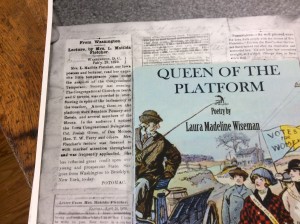
A newspaper clipping from Matilda Fletcher's talk, February 28, 1870

(A newspaper clipping from Matilda Fletcher’s talk, February 28, 1870)

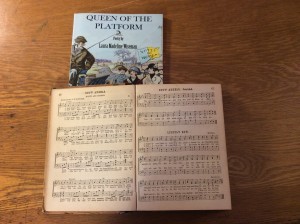
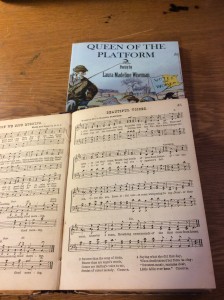
My research allowed me to find out where Matilda was born and some information about her early life. Matilda (Felts) Fletcher Wiseman was the fifth of fourteen children from abolitionist parents, who had fled the South. She was born in Winnebago County, Illinois, and raised on a farm in Durand. All seven of her brothers served in the Civil War. In the late 1960s, Matilda married her school teacher, John A. Fletcher (1837-1875). John served in the Civil War where he contracted tuberculosis, a disease that made him increasing ill. They moved to Council Bluffs where he was a school teacher and a lawyer. They had one child together, Alice “Allie” Fletcher, a child that didn’t live beyond the age of two. The disease continued to ravage John’s health. After the death of their child, Matilda joined the lecture circuit to support herself and her frail husband. She wrote about her daughter. Two published hymns about Allie appear in Song Echo.

Matilda Fletcher's hymn "Beautiful Voices" in The Song Echo

(Matilda Fletcher’s hymn “Snow Angel” in Song Echo, by H.S. Perkins)

Matilda Fletcher's hymn "Beautiful Voices" in The Song Echo

(Matilda Fletcher’s hymn “Beautiful Voices” in Song Echo, by H.S. Perkins)

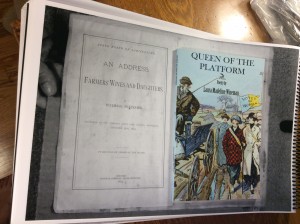
Matilda was a popular lecturer and she quickly began speaking with other lecturers of her time like Susan B. Anthony, Elizabeth Cady Stanton, and Francis Willard. She spoke on suffragist, education, and reform. She also stumped for a presidential candidate, even though she didn’t live long enough to have the right to vote. She wrote and had three books published. The first book, Farmers’ Wives and Daughters, was both published in 1873 by the Lincoln Journal Company, State Printers in Nebraska after she gave the address at the Nebraska State Fair.

Farmers Wives and Daughters, by Matlida Fletcher

(Farmers’ Wives and Daughters, by Matilda Fletcher)

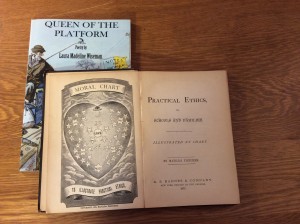
Two years later, her first husband died of tuberculosis in the summer of 1875. That same year, her second book was released, Practical Ethics and published by A.S. Barnes & Company in New York, Chicago, and New Orleans.

Practical Ethics by Matilda Fletcher

(Practical Ethics by Matilda Fletcher)

I’ve always admired that the illustrated heart chart inside the book.

Interior illustration in Practical Ethics by Matilda Fletcher.

(Interior illustration in Practical Ethics by Matilda Fletcher.)

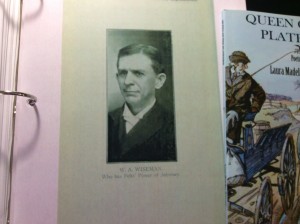
Despite the loss of her child and her husband, Matilda continued to write and speak to earn a living and make a career. She patented a design for traveling trunks for women and wrote bills on educational reform that were passed into law. Eleven years later, she remarried a Methodist minister, my great-great-great-grandfather, William Albert Wiseman (1850-1911), and became stepmother to his three small children, all under the age of ten.

William Albert Wiseman

(William Albert Wiseman, Matilda Fletcher’s second husband.)

Albert became her agent and according to family legend, the family toured the country and the children sang and danced to Civil War Songs whenever Matilda took the stage. (Full disclosure: I’ve yet to find evidence about the children’s onstage presence, but family legend also says that the reason why Albert’s namesake ate dessert first at meals was due to his childhood rearing on the road. Whenever the family arrived via train in another town where Matilda would speak, they headed first to the hotel restaurant and while they waited for their dinner to be prepared, they had dessert.) What followed was many productive years of lecturing and life. For a brief time, the family even moved from Iowa to Texas where Matilda served as assistant minister in a church where Albert was the minister.

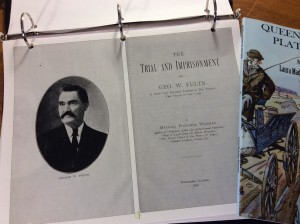
Geo Felts, Matilda Fletcher's younger brother who was charged with murder.

(Geo Felts, Matilda Fletcher’s younger brother who was charged with murder.)

After moving back to Des Moines and to their home in Sherman Hills, Matilda’s brother needed her assistance. In 1905, her brother, George W. Felts (1843-1921), a civil war solider, was charged with murder and sentenced to life in the state prison in Joliet. Matilda writes that Geo was jumped at a saloon. Somehow one of the men involved and a friend of Geo’s, was stabbed. The injury hit the man’s femoral artery. He bled to death. Between 1905 and 1909, with the help of her husband, Albert, Matilda challenged the Illinois court’s ruling, a task that culminated in the publication of her third book, The Trial and Imprisonment of Geo E. Felts: A Deaf Old Solider Robbed of his Rights (1905) and her early death in a hospital in Rockford, IL. Beyond her insistence of his innocence, her contention with his sentencing concerned the court’s failure to accommodate her brother’s disability. Geo was deaf due to his service in the Civil War, a combined result of cannon fire and measles. Throughout the trial, no one provided Geo with a written account of the proceedings, nor did anyone speak directly into his ear-tube, a device through which he could hear imperfectly. In short, Matilda argued that his trial wasn’t legal because Geo neither heard nor understood the charges. All attempts failed. She died at the age of sixty-six and is buried in Des Moines in Woodland Cemetery beside her daughter and two husbands. What became of Geo is unknown. He is buried in Durand Cemetery. This series of poems in Queen of the Platform, partly fact and partly imagination, is where all this research took me.

I’ve had the opportunity to talk about this research in WomenArts Quarterly Journal and the Country Dog Review.

She started lecturing in 1869, shortly after Allie died. John died in 1875. During those brief six years, Matilda lectured hundreds of times, all over the country, and even in Canada. She wrote and published three books. She was an editor and writer for the Iowa State Register (which was renamed as The Des Moines Register in 1903) where she describes her travels, her lectures, and her experiences on the train.

I was able to talk about research and fact and the use of found poetry in Compose Journal.

I wanted poems in Queen of the Platform to offer up a taste of the linguistic phrasings of nineteenth-century newspapers, especially how they recapitulated and paraphrased her two hour lectures. To savor that language, I employed the ghazal, the sestina, and the acrostic.

Reviews of Queen of the Platform are in Weave, Broad Blogs, and The Volta.

With her graceful rhythmic flare, and real and imagined homey narrative, she presents upended views of the meaning of equality via the men around her suffragist ancestor in the time before women could vote…With Queen of the Platform, Wiseman suggests that there is a great man behind–and moreover, beside–each great woman…Wiseman challenges perceptions of feminism and justice, with her poignant and heartfelt writing via the perspective of the inspiring Matilda and the men around her…. -Weave Magazine


Imagine having a great-great-great-grandmother who fought for ‘votes for women’ alongside Susan B Anthony and Elizabeth Cady Stanton. Poet, Laura Madeline Wiseman’s great-great-great-grandmother, Matilda Fletcher Wiseman did just that. Collected letters and newspaper clippings inspired a book of poetry that Ms. Wiseman calls, Queen of the Platform. -Broad Blogs


What makes Queen of the Platform, Laura Madeline Wiseman’s eleventh collection of poetry so different from these other books is that the protagonist of this historical research already had a voice. A loud and influential voice. This book is less the powerful contemporary writer reaching into history to unearth something lost, and more the writer allowing herself to be lost in the rich and varied experiences of a powerful woman who has much to teach a contemporary readership about the nuances of power, gender, and the importance of language. – The Volta

Finally, there’s a YouTube Playlist of readings of poems from Queen of the Platform.

What’s next for my work on Matilda Fletcher and for Queen of the Platform? There’s a Goodreads giveaway for two signed copies going on through the first of August.

Goodreads Book Giveaway

Queen of the Platform by Laura Madeline Wiseman

Queen of the Platform

by Laura Madeline Wiseman

Giveaway ends August 01, 2014.

See the giveaway details
at Goodreads.

Enter to win

There are also copies of the book in my hometown public library, Des Moines Public Library, and my local library, Lincoln City Libraries. Later this year, I’m presenting a paper about my research at MMLA in Detroit.

Traveling the Urban Landscape Panel
MMLA
, 56th Annual Convention
November 13-16, 2014
Detroit, MI

And, it’s being taught this coming term in a university classroom. Hooray! (*Dear unknown poetry student, I hope you enjoy my dissertation that was turned into the book Queen of the Platform. I know I certainly was delighted to write about a super cool suffragist ancestor that I didn’t know I had until I began this research. Enjoy!*)