SATURDAY NIGHT, September 13, 7 pm
The Apollon, 1801 Vinton St
Omaha, NE 68108
About the Anthology and Event:
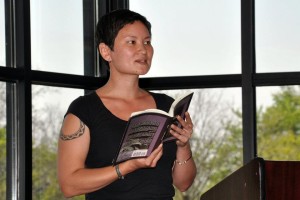
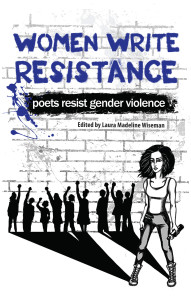
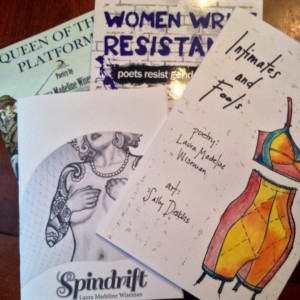
Women Write Resistance: Poets Resist Gender Violence (Hyacinth Girl Press, 2013), edited by Laura Madeline Wiseman, views poetry as a transformative art. By deploying techniques to challenge narratives about violence against women and making alternatives to that violence visible, the over one hundred American poets in Women Write Resistance intervene in the ways gender violence is perceived in American culture. Indeed, these poets resist for change by revising justice and framing poetry as action. This Omaha Lit Fest reading will include an introduction by the editor and feature several Women Write Resistance poets who will read their poems and others from Women Write Resistance.
About the Poets:
Sara Henning is the author of A Sweeter Water (Lavender Ink, 2013), as well as a chapbook, To Speak of Dahlias (Finishing Line Press, 2012). Her poetry, fiction, interviews and book reviews have appeared or are forthcoming in such journals as Willow Springs, Bombay Gin and the Crab Orchard Review. Currently a doctoral student in English and Creative Writing at the University of South Dakota, she serves as Managing Editor for The South Dakota Review.
Jennifer Perrine is the author of The Body Is No Machine (New Issues), winner of the 2008 Devil’s Kitchen Reading Award in Poetry, and In the Human Zoo (University of Utah Press), recipient of the 2010 Agha Shahid Ali Poetry Prize. In 2014, she will serve as a member of the U.S. Arts and Culture Delegation to Cuba. Perrine teaches in the English department and directs the Women’s and Gender Studies program at Drake University.
Leslie Adrienne Miller is author of six collections of poetry including Y, The Resurrection Trade and Eat Quite Everything You See from Graywolf Press, and Yesterday Had a Man in It, Ungodliness, and Staying Up For Love from Carnegie Mellon University Press. Professor of English at the University of Saint Thomas in Saint Paul, Minnesota, she holds a Ph.D. from the University of Houston, an M.F.A. from the University of Iowa Writers’ Workshop, an M.A. from the University of Missouri, and a B.A. from Stephens College.
Laura Madeline Wiseman is the author of more than a dozen books and chapbooks and the editor of Women Write Resistance: Poets Resist GenderViolence (Hyacinth Girl Press, 2013). Her recent books are American Galactic (Martian Lit Books, 2014), Some Fatal Effects of Curiosity and Disobedience (Lavender Ink, 2014), Queen of the Platform (Anaphora Literary Press, 2013), Sprung (San Francisco Bay Press, 2012), and the collaborative book Intimates and Fools (Les Femmes Folles Books, 2014) with artist Sally Deskins. Her work has appeared in Prairie Schooner, Margie, Mid-American Review, and Feminist Studies. www.lauramadelinewiseman.com
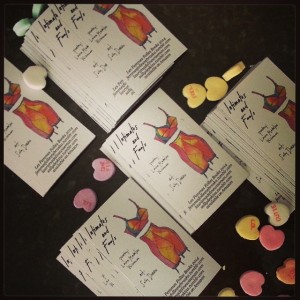
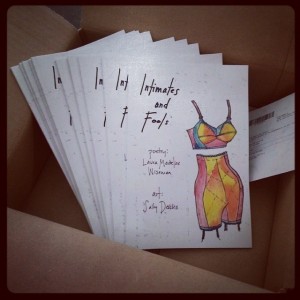
My collaborative book with artist Sally Deskins was released January 1st this year and today is the book’s Half Birthday. Hooray! Happy Half-Birthday Intimates and Fools! I thought I’d post an update on all the fun things and happenings that have been going on.
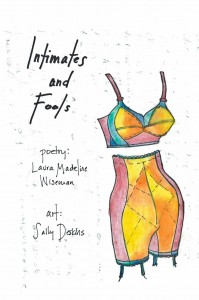
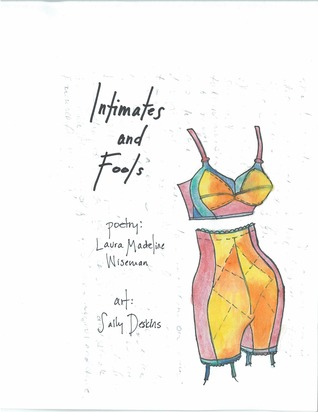
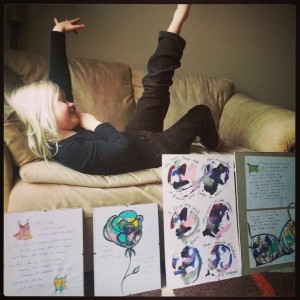
The book couples poetry and body art and illustrations by Sally Deskins. Intimates and Fools intimates the complicating pairing of the female form and cultural notions of beauty while playfully seeking to bare and bear such burdens of their weight. The poetry explores notions of the bra and its place near the hearts of women, while contemplating literary and pop cultural allusions and illusions of such intimate apparel. The body art and illustrations make vivid and bright the female form while calling into question the cultural narratives on such various shapes we hold dear, be they natural, consumer, or whimsy.
Sally and I have had the opportunity to talk about Intimates and Fools in recent interviews. With Julie Brooks Barbour Sally talked about the process of adding the text to her art for Connotation Press.
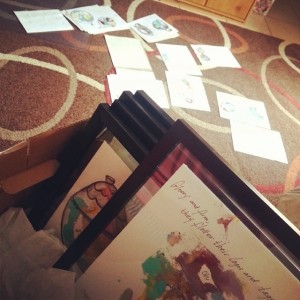
To be honest, each page’s process was different. I didn’t originally start from beginning and go to the end. I selected phrases and sentences I liked, drew images, scanned them into the computer and tried out fonts, but nothing clicked. So I decided to write it myself, first writing the history of the bras in pencil on page one and two. I wasn’t happy with my own handwriting of course, so I erased that, and liked the erased, raw look, and kept some of that in there, as you can see.
Forthcoming in AMRI we discussed the entire collaborative process with Kristina Marie Darling. Specifically, I talk about thinking about how a poem might appear in a book when coupled with poetry. Here’s another sneak peak.
Ultimately, Sally decided to handwrite the poems—a decision I loved. When she illustrated the poem, she broke the lines where it made sense from a visual artistic and literary perspective. It was a “changing, shifting, and expanding” moment for me as a poet, because her visual presentation of the poem was not what I had typed into the computer when it was my poem alone. And yet, this was a collaboration. Sally’s art was being transformed to tell a story about bras and suddenly, so was my poetry.
In Mixitini, this super cool journal that focuses solely on collaborations, we discussed the collaborative work we’d done with other artists and writers. Here’s a sneak peak.
My first collaboration felt organic, fun, and playful. I think there’s something fresh and delightful when art and poetry are combined. The interpretation of poetry that happens when paired with art offers a new way of looking at words and art.
Editor Mel Shapcott featured Intimates and Fools in Wild Women Rising. Sally talked about making body prints.
So at once, the real feelings of the paint on my body is utterly physical and resounds as the sensations are stamped onto paper or canvas. Too it is a means of working out all of the noise of body image — what I should look like according to magazines, movies, the clothing ads, my mind. In these prints, my body looks beautiful in the various acrylic colors. As I mix and swirl the paint on my body parts, the image comes out skewed and conceptual, and beautiful in this state — various colors, shapes, sizes. It is perhaps sensual, perhaps an object in itself, but not decried or distanced, violent or Photoshopped to some advertiser’s view of perfection. It is stunning in its complexity, simplicity and in definition yet materiality, a peaceful yet spirited view of the female figure.
In Blotteraturewe talked about our personal history with the bra and the research we did for the book. I discussed reading about the bra in college.
My first intellectual endeavor into bras was in college when I added a second major of women’s studies after taking one women’s literature class. I took scores of classes—sociology of gender, feminist theory, African American women’s literature—and somewhere in there I read The Body Project: An Intimate History of American Girls by Joan Jacobs Brumberg, a look at the ways in which girls have worked on improving themselves and how that has shifted from a focus on the personality to a focus on the body. One section on body projects made note of bras and I found it fascinating that all women didn’t always wear bras.
We talked about the collaborative composition in Storyacious. Sally discussed her creative process.
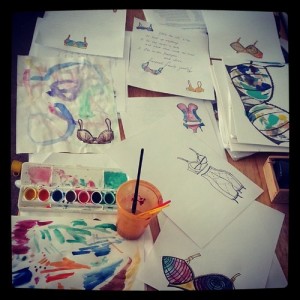
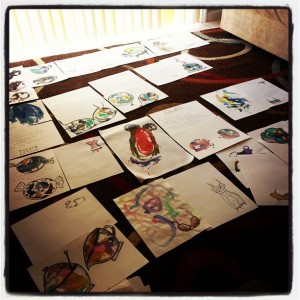
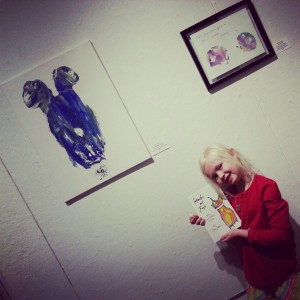
After reading Madeline’s poem, I decided to let it sit, scratch down visions and ideas, and make dozens of body prints in preparation. Instead of the larger torso body prints I had been doing for the gallery shows, I did smaller, page-sized prints of various body parts to allow closer focus and more pause and insight for each word.
“Poet Laura Madeline Wiseman takes what every girl and woman has thought about her breasts and adds a imaginative twist. Artist Sally Deskins fun, contemporary-styled illustrations take it even further.”- Underrated Reads
“…for me what Intimates and Fools is aiming to get to the heart of, and often does quite handily: the struggle against both nature and the commodification of women, a struggle that is defined with and against sexuality, and a struggle that is far more complex than it at first seems. Wiseman and Deskins have created a deceptively pleasant collaboration here, one that is both arch and light-hearted, and which deepens the more it is read and pondered. There are few bra-wearers who won’t see themselves in these clever poems and illustrations; there are few readers who won’t look at bras, and the world, a bit differently after reading this book.” – Luna Luna
“Intimates and Fools is a visually stunning book. This insightful collaboration between poet Laura Madeline Wiseman and artist Sally Deskins gives us not only a look into the bras that hold women’s breasts, but uncovers the history and honesty of what women wear beneath their garments… Throughout, we never leave what holds up the breasts, what women desire in a bra, what women might do without them, even how these intimate garments are cared for over time. This is a book about the female body and what adorns it, what is bought and given away in so many forms.” – Connotation Press
“What we wear under our clothes tells a quiet story, as playfully and artfully explored in the book “Intimates and Fools,” with poetry by Laura Madeline Wiseman and artwork by Sally Deskins… The concept of having a book of illustrated poems dedicated to breasts and undergarments is charming and yet sweetly simple… The artwork of Deskins is so vibrant, with playful poems surrounding their form… the overall feeling from the collection is that of simple joys in these sacred garments we hold close.” – Busting and Droning Magazine
“Deskins’s own art, colorful sketches and body prints, unapologetically splash across the page in bright strokes while Wiseman’s handwritten prose snakes up and around, balancing and accompanying the art… It made me want to linger, to touch the page, run my hands across the color and script. It was more of an experience than just interpretation… it’s what’s just under the busy surface that’s most appealing: the wildly complex social constructs of female body, and the symbol of the bra as the ultimate carrier of all things female: shame, sexuality, strength.” – [Pank] Magazine
“Intimates and Fools is a cheeky, fun read…Laura Madeline Wiseman’s poetry will have you conspiratorially chuckling and each page of Sally Deskins’ painted illustrations are frame-worthy.” - Ivory Owl Reviews
“Women can be mistaken for their sexuality. Or, women can make their sexuality work for them. Intimates and Fools, with poetry by Laura Madeline Wiseman and illustrations by Sally Deskins, is a thought-provoking, conversation-starting coffee table book…Here, brassieres emerge as the main characters…In this love-hate relationship, bras just want a little appreciation. Don’t we all?”- Broad Blogs.
In March, I traveled to West Virginia where my collaborator currently lives. We had super fun reading together at a local art center there. In April, my collaborator traveled to Nebraska where I live. We gave two readings. At the Apollon, we read collaboratively.
Intimates and Fools has also been to readings in Chicago, South Dakota, and elsewhere. I will be giving a reading at MMLA in Detroit, MI about the collaborative process in the Fabricating the Body panel in November. Other recent readings are on our YourTube playlist.
Beautiful pages from Intimates and Fools with Sally’s original art have appeared in shows in galleries in Ohio and West Virginia, and will be featured in Sally’s series “What Will Her Kids Think?” in an exhibit at Future Tenant Gallery, August 8-24 in Pittsburgh. Pieces from that series also appeared at the Ohio University Eastern Campus, in St. Claireville, Ohio in February.
“Les Femmes Folles: WV” had a group exhibit at the Monongalia Art Center, Morgantown, West Virginia in March.
I’m going to be interviewed on It’s the Beat!this week and I’m reading with Grace Bauer and Michelle Menting next week at Tuesday with Writers. Here’s the information for those upcoming events:
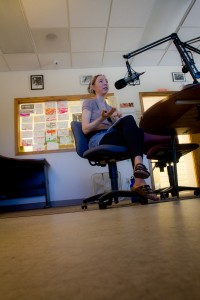
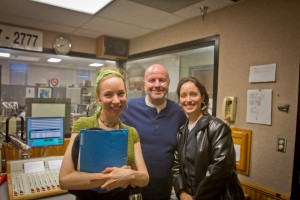
Interview with Karen Sokolof Jovitch & Jody Vinci It’s the Beat Radio show, Mighty 1290 KOIL (am)
noon-1pm, Saturday May 3, 2014
Reading with Grace Bauer and Michelle Menting Tuesday with Writers
7 p.m., May 6, 2014
South Mill, 48th & Prescott
Lincoln, Nebraska
I hope you can catch the radio piece if you’re near a radio Saturday. It will also appear on the site’s website and I’ll link to it here. The South Mill reading with Tuesday with Writers should be great fun!
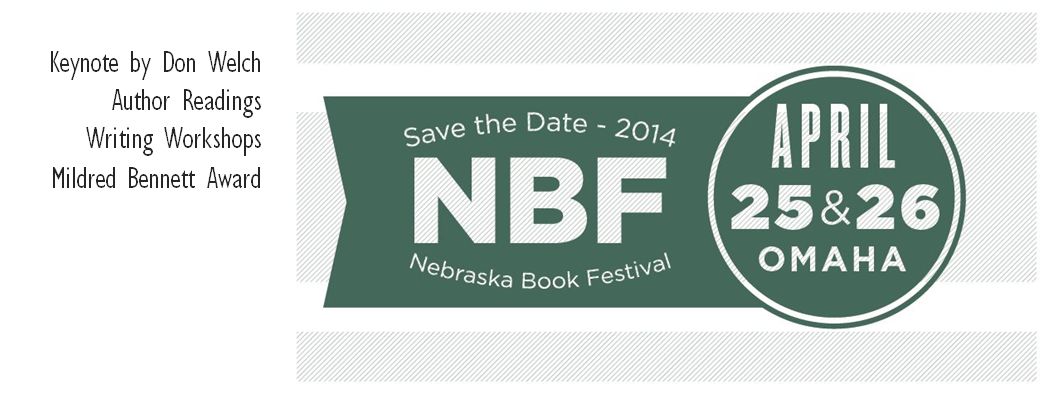
Last week, I read from Women Write Resistance at the Nebraska Book Festival. It was a great turn out! It was such an honor to read from the anthology that I edited. I read from the preface and from a poem by Wendy Barker. I also read from Intimates and Fools and my new book on the bluebeard myth Some Fatal Effects of Curiosity and Disobedience.
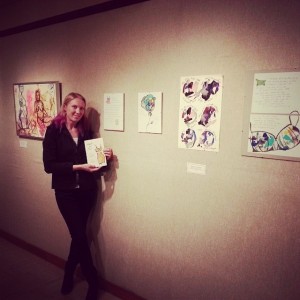
Earlier in the week, I read at Connect Gallery with Sally Deskins and Cat Dixon. It was a great turn out, too!
Finally, Monday I was part of the Bodies of Work: a Collaborative Exhibition and Reading. Sally and I were able to read from Intimates and Fools collaboratively - a real treat!
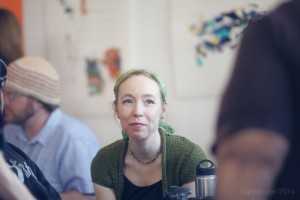
g. thompson higgins photography did a beautiful job at capturing the event. Thanks, Greg!
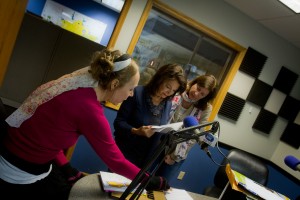
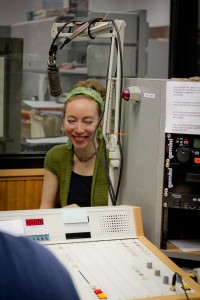
I was graciously interviewed with Rachel Mindrop by Michael Lyon on KIOS-FM early that same morning. It was so much fun! Thanks, Michael!
If you missed the airing, you can listen to the mp3 of Bodies of Work on KIOS-FM, Omaha Public Radio and Michael Lyon. My poem “The Blue Funeral” is about 3/4ths in.
I’m reading today in Omaha. I hope to see you there! Here’s the details.
Omaha, Nebraska, Wednesday, April 22, 2014 ― The Connect Gallery is pleased to hold a poetry reading to celebrate National Poetry Month. Some of Deskins’ work will be on display for this event. Coffee and finger foods will be available for this lunch time reading.
Poet Laura Madeline Wiseman and artist Sally Deskins collaborated in Intimates & Fools. Coupling body art and poetry, Intimates and Fools intimates the complicating pairing of the female form and cultural notions of beauty while playfully seeking to bare and bear such burdens of their weight. Body art and illustrations by Sally Deskins. Laura Madeline Wiseman’s poetry explores notions of the bra and its place near the hearts of women, while contemplating literary and pop cultural allusions and illusions of such intimate apparel. Sally Deskins’ body art and illustrations make vivid and bright the female form while calling into question the cultural narratives on such various shapes we hold dear, be they natural, consumer, or whimsy.
Intimates & Fools, poetry by Laura Madeline Wiseman with art by Sally Deskins, Les Femmes Folles Books, ISBN: 978-0-615-94749-5, 38 pages, Les Femmes Folles Books, January 2014, price: $14
—
Information about Cat Dixon’s book Too Heavy to Carry: People expect that their lives move in majestic sweeps, but that’s only because memory and legend work that way. Reality works in the small moments of our experience. Too Heavy to Carry explores those moments by focusing in close. This collection aims to name the evils that women live through: loneliness, betrayal, inadequacy, and loss. Dixon captures not just the glimpse of hope, but shows the agony and obstacles one must endure before she crawls out of the bottom of the well. This is a must for survivors of any variety-divorce, depression, domestic violence, abandonment/neglect and other painful experiences.
Too Heavy to Carry, poetry by Cat Dixon, ISBN: 978-1622880560, 88 pages, Stephen F. Austin Press, February 2014, price: $16
AUTHOR BIOS
LAURA MADELINE WISEMAN is the author of Queen of the Platform (Anaphora Literary Press, 2013), Sprung (San Francisco Bay Press, 2012), and the collaborative book Intimates and Fools (Les Femmes Folles Books, 2014) with artist Sally Deskins, as well as two letterpress books, and eight chapbooks, including Spindrift (Dancing Girl Press, 2014). She is the editor of Women Write Resistance: Poets Resist Gender Violence (Hyacinth Girl Press, 2013). Her book, American Galactic, is forthcoming from Martin Lit Books. Wiseman has a doctorate from the University of Nebraska-Lincoln. She has received an Academy of American Poets Award, the Wurlitzer Foundation Fellowship, and her work has appeared in Prairie Schooner, Margie, and Feminist Studies. Currently, she is a writer-in-residence at the Prairie Center of the Arts in Illinois. www.lauramadelinewiseman.com
SALLY DESKINS is an artist and writer, focusing on women and feminist writers and artists, heavily inspired by artist Wanda Ewing. Her art has been exhibited in galleries in Omaha, New York, Philadelphia and Chicago; and has been published in publications such asCertain Circuits, Weave Magazine, Her Kind: A blog by VIDA Women in Literary Arts, Vagina, CLAP and Whitefish Review. She has curated various solo and group exhibitions, readings and performances centered on women’s perspective and the body. Her writing has been published internationally. She edits the online journal Les Femmes Folles, and has published three anthologies of art and writing. sallydeskins.tumblr.com
CAT DIXON teaches creative writing at the University of Nebraska, Omaha. She is the secretary of The Backwaters Press. Her work has appeared in Sugar House Review, Midwest Quarterly Review, Coe Review,Eclectica among others. Her full length poetry book Too Heavy to Carry was just released from Stephen F. Austin University Press. Her website is www.catdix.com.
Tomorrow I’m reading from Intimates & Fools at the Apollon. Here’s a link to the press release, but the full details are also below. I hope to see you there!
The Apollon & Les Femmes Folles Present:
Bodies of Work: A Collaboration Exhibition & Reading
One-night only: April 21, 2014
Apollon Omaha, 1801 Vinton St., Omaha, NE
Featuring a collaborative art series by figurative artist Rachel Mindrup, body-artist Sally Deskins, and poet Fran Higgins and A live reading featuring Higgins and poet Laura Madeline Wiseman, author of Intimates & Fools (Les Femmes Folles Books, 2014)with body-art by Deskins.
Art exhibit opens: 6pm (free)
Reading: 6:30pm (free)
SPECIAL EVENT: Drink n Draw, 8-10pm ($5)
We will also be collecting new bras/undergarments, and/or gently used women’s clothing for Heartland Family Service! Heartland Family Service, founded in Omaha in 1875, is a non-profit, non-sectarian social work agency. We help parents who struggle; couples who want to save their relationship; children who are removed from unsafe homes; teens who made the wrong decisions about alcohol, drugs or crime; survivors of family violence; low-income families–mostly women and children–who fall into homelessness; and many, many more who need a helping hand to get back on track. Annually we serve 35,000 to 40,000 people in twelve counties. heartlandfamilyservice.org
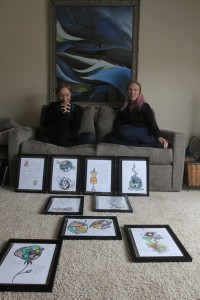
Collaborative Series (above: “Grammar Man”): Poet Fran Higgins, body-artist Sally Deskins and figurative artist Rachel Mindrup come together to create a series of mixed-media work that explores body image, art history, womanhood and motherhood, furthering their “Mother-Artist” project originally debuted Feb. 2013. The trio of artists started with Deskins’ acrylic body-painting; “Inspired by Yves’ Klein’s Anthropometries, I take a feminist approach, as artist, model and director, examining how our outside selves both hides and radiates our mind,” describes Deskins of her approach. Thereafter, Mindrup was given the twenty large works to draw on at her discretion; “Usually I spend so much time painting figures, paying attention to every resolute detail; with this series, I wanted to draw quickly to echo Sally’s swift body-printing method, and I kept seeing these mythological characters, coming in and out of the body parts like the bodies represented a whole world,” describes Mindrup. Mindrup then passed the work onto Higgins who, penned ekphrastic poetry on each, based on her own perspective, displaying irony, hilarity, and sometimes raw truth on the female, motherhood, and human experience.
Intimates & Fools: Coupling body art and poetry, ‘Intimates and Fools‘ intimates the complicating pairing of the female form and cultural notions of beauty while playfully seeking to bare and bear such burdens of their weight. Laura Madeline Wiseman’s poetry explores notions of the bra and its place near the hearts of women, while contemplating literary and pop cultural allusions and illusions of such intimate apparel. Sally Deskins’ body art and illustrations make vivid and bright the female form while calling into question the cultural narratives on such various shapes we hold dear, be they natural, consumer, or whimsy. The book is published by Les Femmes Folles Books, 2014 and is available on amazon.com.
Les Femmes Folles is a completely volunteer run organization founded by Sally Deskins in 2011 with the mission to support and promote women in all forms, styles and levels of art with the online journal, books and public events; originally inspired by artist Wanda Ewing and her curated exhibit by the name Les Femmes Folles (Wild Women). Les Femmes Folles Books is a micro feminist press that publishes 1-2 titles a year by invitation. Other books include Les Femmes Folles: The Women, 2011, 2012 and 2013, also available at this event and at blurb.com. femmesfollesnebraska.tumblr.com
The Apollon is Omaha’s multi-genre arts and entertainment hub where all are welcome to indulge their tastes in a place of welcome and warmth. The Apollon experience is co-created by a vibrant, well-supported arts community and an equally vibrant, well-rewarded audience. apollonomaha.com
Fran Higgins earned her BFA, graduate certificate in Advanced Writing, and a Masters in English from the University of Nebraska Omaha. Her work has appeared in Plains Song Review, Celebrate, SlipTongue, NEBRASKAland magazine, and The Untidy Season: An Anthology of Nebraska Women Poets.
Rachel Mindrup is a professional artist and art educator. Her current painting practice is about the study of the figure and portraiture in contemporary art and its relation to medicine. Mindrup’s client list includes: Kiewit Corporation, Boys Town, Creighton University, Boys Town National Research Hospital, and the Kansas City University of Medicine and Biosciences. Her artwork is held in many private collections including those of Primatologist Jane Goodall and Supreme Court Justice Clarence Thomas. Rmindrup.com
Laura Madeline Wiseman is the author of more than a dozen books and chapbooks and the editor of Women Write Resistance: Poets Resist Gender Violence (Hyacinth Girl Press, 2013). She holds a doctorate from the University of Nebraska and has received an Academy of American Poets Award and the Wurlitzer Foundation Fellowship. Her work has appeared in Prairie Schooner, Mid-American Review, Margie, and Feminist Studies.
Sally Deskins is an artist and writer, focusing on women and feminist writers and artists, including herself. Her art has been exhibited in galleries in Omaha, New York, Philadelphia and Chicago; and has been published in publications such as Certain Circuits, Weave Magazine, and Painters & Poets. She has curated various solo and group exhibitions, readings and performances centered on women’s perspective and the body. Her writing has been published internationally in journals such as Stirring, Prick of the Spindle, Bookslut and Bitch. She edits the online journal Les Femmes Folles, has published three anthologies of art and writing and her first illustrated book Intimates & Fools, with poetry by Laura Madeline Wiseman, was published in Jan. 2014. Femmesfollesnebraska.tumblr.com, Sallydeskins.tumblr.com
SPECIAL EVENT: DRINK N DRAW, 8-10pm, 19+
Drink n Draw Omaha is a socially creative event inviting artists (painting, sculpting or drawing) to come and practice their craft inspired by two professional art models. Cost is just $5 for artists 19+. Bring your own supplies and take advantage of APOLLON’s beverage service. No photography permitted. (Photo above by Drink n Draw photographer g thompson higgins.)
In the July/August 2013 Issue of Poets & Writers, Kevin Samsell coordinator of events at Powell’s books asked several of his favorite readers how they’ve gotten good at readings. Dan Kennedy explains “before I walk into the room every damn nervous tic comes out and I think, especially, that makes for an entertaining evening for folks…I’m from a kind of working-class background where I feel like, you, know, people have lives and a lot to do…keep it interesting and paced and moving.” (74). I have two questions. First, I’m curious about your sense of your own nervous tics and if they help or hinder you as you approach the stage and/or how have you observed it in other writers? Kennedy also speaks about class and the awareness of how busy we all are. Second, how do your background and the background of the audience influence your sense of how to approach those moments on stage?
I can’t say whether I’ve become “good at readings”—that’s a call for others to make—but I sure can say I enjoy them more than ever! Used to be, back when I first started, around 1981, I’d be so nervous before any reading that I’d descend into what one friend called “Wendy’s Blue Lagoon.” I couldn’t talk or interact with anybody much at all till after the reading. And for years I’d be shakily anxious before any reading, whether for five people or five hundred.
But now, I’ve “performed” enough that usually, and I mean usually, I’m not very nervous. Even still, I always find my nose running before it’s my turn at the podium, at the mic, so I have to fold a tissue into a book before I face an audience. Strangely, after that point, I seldom need the tissue at all. Same with water. I’m obsessively sipping water in the five or ten minutes before I’m “on,” but, once standing before a group of listeners, most often I don’t need anything at all.
But that doesn’t mean I’m not focused. Preparing for a reading takes time. I like to know what kind of audience it will be. Students? And what kind of students? Community college in South Texas, or in Brooklyn? Upper-level and grads at a high-tuition private university? A writers’ group? General community group? What ages? Ethnicities? Region of the country? Of course I can’t always predict, but if I know, for instance, that an audience will consist primarily of people over, say, fifty, I’ll plan a very different reading from one designed mainly for twenty-year-olds who are juggling two part-time jobs and a twelve-credit-hour schedule.
When it comes to planning, I’ve learned enormously from watching and listening to other poets read their work. Readers such as Galway Kinnell, Sandra Gilbert, David Kirby, Denise Duhamel, Alicia Ostriker, and Barbara Hamby are superb models. Although I think some of the best readings I’ve ever heard were given by Ruth Stone, who seldom said a word between reading each of her poems, I seem to do better by giving the audience a little background, a little breather between poems. And I’m enough of a hambone that I like to get a chuckle or two here and there. So I’ll spend as much time planning my between-poem remarks as I do practicing reading poems aloud.
And I time myself over and over. Once, back in the 80s, I gave a reading at a friend’s university where, without realizing it, I went on and on for an hour and a half. The person in charge of the reading was polite, but direct, and I’ve never done that again! I was just having too much fun, and the students were laughing at all my jokes! But that was a serious breach of poetry-reading-etiquette, and I like to think I’ve never goofed in that way since.
Another horrific mistake I once made, one even more disastrous, was to read a poem about my middle-school-aged son while he was in the audience. It was a traumatic experience for him, one for which I’ve had a hard time forgiving myself. So ever since, I’ve been especially careful to make sure that I’m not violating anyone’s privacy. Even before I’m introduced before a reading, I like to check out the audience to see if something I’d planned to read might offend someone for some reason. Sometimes after I’ve launched into a performance, I can tell from audience reactions that I should drop a particular poem from my script, or substitute something else.
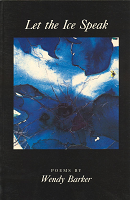
But then, I can’t always read an audience accurately. Once I was giving a reading before about five hundred people, standing behind a huge podium on a large stage far above the audience. As I continued with my planned program, I began to notice that many heads in the audience were bent down. “Oh no!” I thought. “I’m bombing.” It was all I could do not to slink off the stage and run to my car in tears. But I soldiered on, and, after I concluded the reading, thanking everyone, I was amazed at the enthusiastic applause, all the heads bent up now, beaming at me. I sold dozens of books afterward, for people who said they were so moved by my poems they began crying, and had to look down at the floor in order not to burst out sobbing. I was reading poems from Let the Ice Speak, the collection published in 1991 with poems that deal with the death of my father.
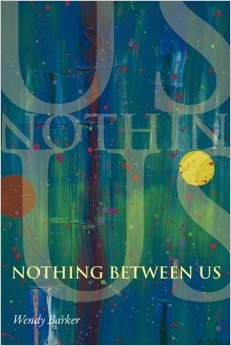
So I have to be careful—I don’t always know how my words are being received. More recently, on the road with my latest book, Nothing Between Us, a “novel” in prose poems (more accurately, a thinly-disguised memoir) about my years teaching ninth grade in West (read mostly African American) Berkeley in the 60s, with a narrative thread following a passionate affair between a young, white, married (guess who) English teacher and an African American colleague, I have been especially nervous because the subject matter of these poems is racially and sexually explicit. But I’ve found that the people I’ve worried most about, African American listeners, have been the most receptive. Often after reading from this collection, I’ve had African Americans come up to me afterward, tears in their eyes, thanking me for my honesty, wanting to hug (and I’m always up for a good hug), and buying a dozen copies of the book, one for every family member.
One hurdle I have to jump almost as soon as I confront a mic has to do with my appearance. One new poet friend joked, after hearing me read, that she was shocked and delighted at my humor because I “look so proper.” I’m tall, blue-eyed, once blonde but now gray-silver-haired and have been described as “elegant.” So that may be one reason I work in the beginning of a reading to establish myself as a person who doesn’t need—or want—to handle the world with white kid gloves. I have to dispel any prejudices audience members might have based on my appearance. That’s one reason I don’t usually wear pastel colors, but prefer black and strong dark colors, lest I be taken for one of those “ladies who lunch” who don’t want to be shocked out of their comfort zone.
And how to decide which poems to read? If a new book has recently been published, of course I’ll want to feature those poems. But I think sometimes I err on the side of reading too much new or recent work, ignoring poems that appeared in past collections. But whether new poems or old, I always think of a reading as a kind of concert. I want to take the audience through a series of experiences, and so I plan with great care the way poems will build on each other. I may alternate, for instance, between a meditative mood, hilarity, and pain. I like to end with a funny poem, if possible.
I love giving readings. It’s a way of reaching out and touching others. Of sharing words that come from my inner self and that, I always hope, reach to the inner core of others. I love the conversations that build after a reading, when people come up and share experiences related to those I’ve spoken about in the poems I’ve just read. It’s a matter of creating threads among people, threads that can weave us closer together.
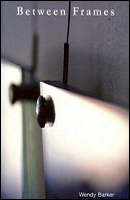
I taught your collection Between Frames (Pecan Grove Press, 2006) in my advanced poetry workshop on the chapbook last term and one of the things we talked about was your use of the prose form in the poems that focused on film. Your fabulous and smart book Nothing Between Us (Del Sol Press, 2009) also uses the prose poem, flash fiction form. In Michel Deville’s essay “Stranger Tales and Bitter Emergencies: A Few Notes on the Prose Poem in An Exaltation of Forms (2009) edited by Annie Finch and Katherine Varnes, he traces the origin of the form to Gertrude Stein’s Tender Buttons (1914) and notes how the form uses “virtually all the devises of poetry” (262) as it “tends to include or exclude, subscribe to or subvert” (263) the genre. Though he notes the difficulty of such delineation, he divides the form into two camps, the “narrative” and the “language-oriented” trend (262), while noting that it is “a relatively young genre still in the process of self-definition. Moving back and forth between lyrical, narrative, philosophical, and critical material, the prose poem can be seen as part of a more general movement in contemporary literature towards the dissolution of generic boundaries” (266). First, given that the prose form only appears in certain poems in Between Frames, what is your sense of the unction of the form in that chapbook compared to its use in Nothing Between Us, entirely composed of the form? Second, if you had to assign yourself into one of Deville’s campus, which would you assign and why?
First, Madeline, a huge thank you for using Between Frames in your class! And bushels of thanks too for your kind comments about Nothing Between Us.
Yes, prose poems. How I love this form, which is a form between forms, neither prose nor poetry. I adore the fact that the line dividing a prose poem from a work of flash fiction is so slender it’s barely visible. And it’s a joy to find there’s so much interest in this form that can make use of every poetic device we find in lineated verse with the exeption of the line break. As you know, whereas in poems composed in lines, the tension between the the structure of the line and the structure of the sentence create pace, rhythm, and even meaning, in the prose poem it’s the sentence—and the play between sentences—that governs the poem’s rhythm.
Of course, although traditions of poetic prose have existed for centuries (with the Japanese haiban, the Chinese fu, texts transcribed from oral traditions of indigenous peoples, and passages from the King James Bible), it was the publication in 1869 of Baudelaire’s Paris Spleen that constituted the first major attempt by a Western writer to question accepted formal premises with emphases on end rhyme and meter. And recently, as you suggest, prose poems have become a popular sub-genre, with numerous anthologies of their own, including, for instance, Brian Clements and Jamey Dunhan’s An Introduction to the Prose Poem (2009).
I first discovered the prose poem form in Sandra Gilbert’s graduate poetry workshop at UC Davis in the late 70s, when Sandra had us read Robert Bly’s The Morning Glory. Those poems, to paraphrase Emily Dickinson, took the top of my head off. And one of the prose poems I wrote in that workshop, “Grandfather,” appears in my first collection, Winter Chickens (1990). But for years afterward, I’d ignored the form, until the early 90s, when I began a sequence of poems—funny ones, I hoped, and ironic—taking the various parts of male and female reproductive systems and having them speak. I have no idea where this notion came from, but I was on a roll, writing prose poems in the voices of ovaries, sperm, and fallopian tubes. I’d been working on this sequence when in 1994 I was selected to be a fellow at the Rockefeller Institute at Bellagio in Italy.
But once there, high above Lago di Como in June, breathing the scent of jasmine, everything, everything changed. That story, however, belongs in my response to your third question, so for now, I’ll simply say that, perhaps because I’d been writing in that form for months, the poems comprising Nothing Between Us emerged as prose poems from the start. There was no question of tinkering with line breaks and stanzas—the subject matter was too urgent. These pieces had to spring forth like gasps, as utterances so long withheld they could no longer be suppressed. And oh, yes, they’re narrative. They don’t have—didn’t have—the luxury of playing around with syntax. They’re trying to recreate voices I’d almost forgotten, incidents that I’d blocked from memory, but as I wrote, came flooding back. And I hope the poems are lyrical. I rely on metaphor throughout—weaving, threads, fabric work (all of which I was heavily “into” in the 60s) become metaphors for relationships, especially interracial relationships, and candy, sweets, ice cream become metaphors for the love relationship that builds through the book. And throughout, I was always concerned with sounds, with rhythms. Often I was playing with the rhythm of a particular kind of music, as in “Sax.” And even more often, I was playing with the rhythms of different kinds of colloquial speech.
But now to answer your other question, which you actually posed first. Between Frames was one of those rare joys for any poet: Palmer Hall—a beautiful human being, wonderful editor of Pecan Grove Press, and a fine poet greatly missed since his death several months ago—asked me to send him a manuscript for Pecan Grove. Now how many times does a writer, a poet, have that opportunity? I was honored, and used the chance to piece together some poems I’d been working on since around 1998. Most of the poems in the chapbook were written shortly after my divorce from my first husband and my moving in with, joining my life with, Steve Kellman, whom I married in 2005. They’re transitional poems, written during a period of grief over the much needed but still painful divorce and the difficulty of moving on. The collection culminates with the prose poem “Wedding Crashers,” playing with the plot of that movie along with the joy of Steve’s and my wedding.
Steve is not only a brilliant biographer and scholar, but he also serves as a book, film, and theater critic. So until recently, when he began focusing primarily on reviewing books and plays, I would join him for film screenings in San Antonio—sometimes he’d be assigned to review three or four movies a week. And, obsessive poet that I am, I found material for poems in many of the films, as well as in the dynamics involving the various film critics during the screenings. Probably since those pieces were dealing with a movie’s narrative, and since they often dealt with painful subjects, the prose poem form once again felt natural. With these pieces, I didn’t want interruptions other than paragraph breaks. There are only four of them in the chapbook. Quite frankly, although I tried, I couldn’t compose a whole series.
And soon, I was on to another obsession, poems about cloud formations and weather, short, lineated poems that comprised the next chapbook, Things of the Weather (2009)
I still love the prose poem form, and recently have begun using it again, finding it ideal to express complexities involving my mother’s bizarre British background that, I’m only now realizing, influenced me far more than I’d ever thought. So again, as with the poems in Nothing Between Us, material is oozing out, shaped by strange connections. And again, although the voice is conversational, I hope this work is lyrical, that it has a kind of internal music.
And what happened to the prose poems about reproductive parts? Abandoned. Never published. But they led to Nothing Between Us, to the prose poems in Between Frames, and about twenty years later, to the current work in my new manuscript-in-progress.
Obviously, if I had to subscribe to one of Michael Deville’s camps, I’d say all these poems belong squarely in the narrative group, with a hope that they’re also lyrical. But—and I quite realize that this predilection may place me in a “camp” that’s unfashionable—I’m not interested in writing more “language-oriented” poetry. As for using language that is packed, that does double-, triple-duty, I continue to believe that the prose poem can subvert all kinds of things, even when the language appears to be straightforward.
In her interview in the March/April 20013 issue of The Writer’s Chronicle Kim Barnes asks “what is coming of age like for women?” (108) and then cites her female students’ answers of “you start your period, you shave your legs, you get married, and you have babies” (108). Barnes notes that in her novel In the Kingdom of Men she wanted “to tell the difference between the coming-of-age story of men and that of women” (108). Your book Nothing Between Us seems to me to be a coming-of-age story, a maturing, a re-seeing of the world for the narrator. Can you talk about this?
I started writing the prose poems of Nothing Between Us: The Berkeley Years (which originally had been titled simply The Berkeley Years) in 1994, when I was almost fifty-two. I’d been married for thirty-two years.
As I mention in my response to your Question 2, the poems began while I was a resident at the Rockefeller Center in Bellagio. Surrounded by the lush foliage and blooms of its 18th-Century gardens and perched above all three branches of Lago di Como while looking toward the Alps, Bellagio’s Villa Serbelloni is one of the most beautiful places in the world.
The landscape must have reminded me of the Berkeley hills, also lush with flowering shrubs and high over glimmering water. But what began the poems had much to do with a conversation one evening after dinner with another fellow at the Villa, a distinguished economist who reminded me of my father. Our group been engaged in a lively discussion about whether poems should tackle political sensitive subjects, and Pierre Crosson and I had kept on talking together after the rest of the residents had scattered to other corners of the room. Somehow I found myself telling Pierre about my experiences in the late sixties while a young, white, married middle-school English teacher in a primarily black West Berkeley neighborhood a few blocks from the newly established Black Panthers’ headquarters. He seemed spell-bound, and burst out, “You must write about this!” What I hadn’t told him was that, during those years, I became involved in an intense affair with an African American colleague. I simply said that I couldn’t write about those years because the subject matter was politically incorrect and besides, I had a husband whose feelings I needed to consider. Pierre’s response was stunning: “Oh, hang incorrectness, and hang husbands!” he cried. “When,” he went on, his voice raised above the group’s conversational hum, “have male artists ever considered the feelings of their women? You’ve got to start writing about all this!”
I did. The next morning, high in my 11th-Century tower room, I wrote a draft of what became the final poem in Nothing Between Us. “After” is really a summary of the whole book. As if the events of that period came pouring out in one gasp, one small paragraph. And from that point on, for four years, the poems burbled forth.
The book could definitely be seen as a “coming of age” story. A story of a young woman in an environment that often feels (and is) hostile, even dangerous. Of a young woman who, although she had wept at Martin Luther King’s famous speech, and saw herself as a passionate supporter of civil rights, nevertheless encounters hatred because of her whiteness and unfamiliarity with the backgrounds of many of her students.
But the narrator of the “novel” is also not prepared for the “bullshit” of many of her male colleagues, and, having never thought of herself as attractive, is surprised and thrilled, rather than offended, at finding herself a target of sexual attention. Partly because her husband is immersed in his own work and is so often critical of her, Ty’s ” invitations” ultimately persuade the narrator to become involved with him, even though, as she says in “Eugene Thompson, The Hall Monitor,” she’d never thought about “going to bed with more than one person.” So the book is definitely a coming-of-age story in terms of a sexual awakening.
And of course, it’s an awakening into the realities of what it meant at that time to be black and to be white in the United States. The narrator learns much more than bedroom knowledge throughout the book. And in the end, it’s a “sadder but wiser” person we’re left with. Interracial marriages at that time were not only outlawed but often just plain dangerous in many parts of the U.S. As Ty warns the speaker in the poem “Bullshit,” when she pleads with him to marry her, she doesn’t “know how hard it could get.” In Berkeley, okay—there were, as the first poem in the book suggests, a number of mixed-race marriages. But other parts of country? You could be killed. (I still think of Obama’s mother’s courage.)
But Ty isn’t the marrying type, and since, as the narrator says in “Couple,” I couldn’t imagine not being married to somebody,” she returns to her white husband, to her marriage, although it feels like “going dead,” “clos[ing] down shop,” and “mov[ing] back to the desert,” as she laments in “Last.”
Sadder but wiser? Oh yes. And with a painful sense of what has been lost. Of the poignancy of what could have been. Of a missed chance.
The collection, however, was also a “coming of age” in another sense for me as a writer. For decades I’d buried memories of this period of my life deep underground, but once I tapped the vein, the material flowed out like a gushing oil well. And in reliving that period in my earlier life, I found myself at a turning point in the present. Although my marriage had been rich in many ways, there were underlying rifts growing so large that, on my own at Bellagio, I began to realize they could never be closed. This is not the place to describe the problems of the marriage, but to say that the writing of the “novel” (which is really a memoir) empowered me finally to leave that marriage and to begin life anew in my middle-fifties. It was as T.S. Eliot said, a “use of memory” for “liberation / From the future as well as the past.”
In love the conceit of Poems’ Progress (Absey and Co., 2002) and the ways you talk about the changes your poems go through as they’re revised—it’s such an important book for writers, for students, for scholars. I’m wondering if you can talk about the movement of poems into books and chapbooks. How important is it for you to craft and develop the individual poem, and then craft those individual poems into a chapbook, as opposed to simply having a chapbook length collection of poems? Do you write poems towards a series/book with that idea of the book propelling each new poem into creation? Do your poems change radically when they’re placed into a series?
I’m so glad you like the way Poems’ Progress is organized! That book is the product of a dream relationship between author and editor. The encouragement, patience, and expertise of Ed Wilson at Absey & Co. did much to create that book, which includes several poems I hadn’t been able to fit in earlier collections.
Though my first two books, Winter Chickens (1990) and Let the Ice Speak (1991) don’t contain poems consciously written as parts of a sequence, individual sections include poems following certain themes. The second section of Let the Ice Speak, for instance, is composed of poems that revise fairy tales or myths, and the first section includes poems about family memories. The second section of Winter Chickens includes poems about travel. Those two collections were a nightmare to organize! I’d removed a number of poems from the manuscript I’d been organizing, until Sandra Gilbert said I’d been too ruthless. So I pulled out all the poems I’d deep-sixed, and made two piles, one of more kitchen-, home-centered poems written in the late 70s and early 80s, and one of the more family-oriented poems that had been written mostly in the late 80s, around the time of my father’s death. The first pile became Winter Chickens, and the second, Let the Ice Speak. Amazingly, only a couple of months after I began to circulate the two manuscripts, both were accepted, Winter Chickens by David Bowen of Corona Publishing Company, and Let the Speak by Joe Bruchac of Ithaca House Press.
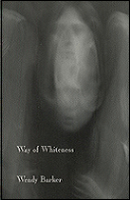
And like those two earlier collections, the poems in Way of Whiteness (Wings Press, 2000) were written poem by poem, ultimately organized to follow—albeit loosely—an emotional arc, if not a narrative one. Most of those poems were composed in the early 90s, around the time I was turning fifty.
It was in 1994, as I mention in my response to your second question, that I began consciously writing in sequences. And, with a few exceptions, since then I’ve composed most of my poems as parts of a series.
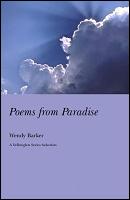
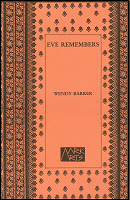
But you asked how important it is for me to craft the individual poem and then work it into a chapbook or collection. And of course, the writing and rewriting (and rewriting, rewriting, and rewriting) of each poem is crucial. But more and more, since Nothing Between Us and Poems from Paradise (Word Tech, 2005), I’ve thought in sequences. Like the Berkeley poems of Nothing Between Us, Poems from Paradise also began at Bellagio. The little poems included in that book also deal with the subject of a love relationship, but in a very different way. I’d been working with a Bengali collaborator, Saranindranath Tagore (a descendant of the Nobel-Prize-winning Indian poet) translating the final poems of Rabindranath Tagore, and had been immersed in Eastern thought and poetry. So the pieces in Poems from Paradise speak of a human love relationship as a movement toward a sacred union. Throughout, I was also trying to revise the story of Adam and Eve—a sort of “why did they have to leave the garden” over-arching question that also seemed to ask “Why did they have to be separated”? The poems first appeared as a chapbook called Eve Remembers, published by Sudeep Sen’s fine Aark Aarts Press. But the poems wouldn’t stop, so eventually they grew into a book.
You asked if poems change when they’re positioned in a series. With the Berkeley poems, I made many changes as I began to work them into a book manuscript. I realized that I had to change names of various characters and also combine qualities of characters, so that a reader would follow certain students and teachers throughout, along with following the love story between the speaker and the character Ty. I went back and forth looking for images that worked as controlling metaphors—like candy, sweets, weaving, threads, birds, and intensified those. I had to make sure the chronology worked in terms of the narrative arc. So, many of those prose poems did change, and change radically, after I began organizing the book. I wrote the last of those poems in 1998, but continued to tinker with the manuscript right up until 2008, when Michael Neff accepted it for Del Sol Press.
Since 1998, I’ve followed several other themes. Around 2000, I became fascinated by phenomena having to do with weather—the names of cloud formations, for instance. I read everything I could find about weather, even annoyed my patient husband by wanting to watch the Weather Channel. Those poems resulted in the chapbook Things of the Weather (2009), thanks to Pudding House Press.
After the obsession with the landscape above and beyond us, in the atmosphere, left me, I became interested in more earthly subjects, like colors, and where they come from, how paint is made, for instance. Several of these poems morphed into ekphrastic poems having to do with colors and their effects on us. But I only managed to complete around a dozen of these before becoming gripped by another obsession. Actually, come to think about it, there might be enough for a chapbook! Which, by the way, I see as a wonderful format—one that can include a series of related poems that often can be relished in one sitting, and then, of course, reread and reread.
In 2006, after dealing with the death of my mother in 2004 and some health problems of my own, I was seized by impulses to write about teaching. I began teaching in 1966, at first in a high school, then junior high, and then, of course, college, so at that point, I’d been teaching for forty years. The teaching poems burst out one after the other in torrents, although, especially because each poem followed a particular spatial form, finishing one often took many months and hundreds of revisions. These were poems about the intersections of literary texts, students’ comments, reactions, their lives, realities, and mine. Most have seen publication in journals, and one of them, “Books, Bath Towels, and Beyond,” which originally appeared in The Southern Review, is included in Best American Poetry 2013. The book manuscript is—I think—about finished, and I’m hoping for a good publisher.
And now? I’m working on poems about my mother’s bizarre British heritage, with the effects of her family and their past on the present. Hawthorne’s character Holgrave cries out in The House of the Seven Gables, “Shall we never, never get rid of this Past”? But as Faulkner famously said, “The past is never past.” So I’m playing with the notion of past influences on the present along with an acute sense of the ways our behaviors—and possessions—past and present—affect each other as humans and, although this may sound grandiose, also the planet and its amazing flora and fauna. It’s a big subject, requiring much research, but once again, I can’t seem to stop.
So, in brief (finally!), ever since somewhere around 1994, I sure do think in sequences. You can just call me obsessed!
Your chapbook Eve Remembers (Aarak Arts, 1996), which has a super funky cover that I adore, became part of your full collection Poems for Paradise (WordTech, 2005), a book published nine years after the chapbook. Sometimes poets have published poems they never collect into books/chapbooks, poems in chapbooks never folded into books, or sometimes whole chapbooks that are never folded into books. I’m always curious about what poets abandon or uncollect as well as what we decide to transport from a chapbook into a book, especially when there is a gap of several years. Can you talk about that process for these two collections and/or others? Is there, for example, a future book place for the lovely, fun, and smart poems in your Pudding House chapbook Things of the Weather (2008), perhaps nine years from it’s publication date, in say 2017?
I’m so glad you like the cover of Eve Remembers! I love it too—it looks rather like a richly embroidered fabric. As I mention in my answer to Question 4, Sudeep Sen, a fine Bengali poet who was visiting San Antonio in—1995?—designed and brought out the chapbook through his press Aark Arts. I was thrilled, because I wasn’t sure those little poems added up to anything at all.
And then, they just kept on coming. I couldn’t stop them. All the poems that grew out of Eve Remembers and are included in Poems from Paradise were written during the same period I was working on Nothing Between Us, between 1994 and 1998. During those years I was painfully examining love relationships on many levels, aware of attempting to revision that primal love story set in the Garden of Eden. Not surprisingly, it was in 1998 that I divorced my then husband of thirty-six years. Shortly after, I joined my life with Steve Kellman, whom I married in 2005. The last poem in Poems from Paradise, “If a God,” was really written for Steve, and is the only poem in the sequence for which I had him in mind.
Now as for the poems in Things of the Weather (and again, Madeline, I’m thrilled you like the collection), I wished I could have kept the series going! As I explained in my response to Question 4, those poems were written around 2000-2004, but then my interests shifted to earth and its colors—where various colors originate, how they’re manufactured for our use, what they suggest. During that time I also wrote a group of ekphrastic poems. My recent poems, begun around 2007, about teaching, literary texts, and my experiences in the classroom, obsessed me for about six years. I’m currently circuating a book-length manuscript of poems on those subjects.
What is inspiring you these days?
And what is inspiring me these days, other than reading so many marvelous poets, too many to name here? I subscribe to numerous journals, and try to follow the work of poets whose work I particularly admire.
How are you trying to get better as a poet?
As for how I try to become a better poet, I would simply say I work at it. I read and read and write and revise and send my stuff to other poets whose advice I trust and revise and rewrite some more. Over and over I ask my patient husband’s advice. The process is never-ending! And it’s rich, it’s what keeps me going. I adore exchanging poems with other writers—it’s one of my favorite things to do in life.
Number of chapbooks you own and number of chapbooks you’ve read: I’m not sure how many chapbooks I own. Among my two or three thousand books of poems by British and American poets, collections of translations from languages other than English, and anthologies of poetry, I’d say only about a hundred are chapbooks. It’s a wonderful format—perfect for a long series, with a length perfect for reading at one sitting.
Ways you promote other poets: I hope I promote other poets in several ways, including my eagerness to exchange poems with other writers and my propensity to purchase collections of poetry. Here at the University of Texas at San Antonio, I’ve been active in bringing poets to our campus (and raising the funds to do so) since 1983. I also make sure that, for every poetry workshop I teach, the students buy at least seven or eight poetry collections published within the past few years. And in my position as poetry editor of Persimmon Tree: An Online Journal of the Arts for Women Over Sixty (edited by Sue Leonard), I orchestrate twice-yearly contests judged by other poets whom I select. The journal is a quarterly—so the other two annual issues feature a well-known poet of my choosing. I have a large correspondence with poets from all over the United States and beyond, and I cherish those friendships, even though many of those folks I seldom see outside of—thank goodness for the conference—AWP.
Where you spend your poetry earnings: Poetry earnings? What a question! The occasional $50 or $100 for a poem, or an honorarium for a reading, simply contributes to the “general fund.” Maybe I should put those modest earnings aside, but so far, they’ve simply gone to help keep life going.
Inspirations and influences: As for inspiration and influences, they are too many to name. But I must start with the brilliant poet, teacher, and critic Sandra M. Gilbert, who, at the University of California at Davis (where I received my Ph.D. in English), mentored me and supported my work in ways I can never repay. And Ruth Stone was a terrific poetry grandma to me. It was Ruth who said to me after I’d asked her if my early poems were any good: “Well, Honey Baby, can you stop?” That was the most important question of all, and of course, my answer was and continues to be “No.” Alicia Ostriker has been a giant support and inspiration also—I think of her as my “Poetry Auntie”—and I am deeply grateful for her own marvelous work and wisdom. These three women have, at different times and in very different ways, through their mentoring, their writing, and their examples, all been giant influences and have provided major inspiration.
My readings have changed, of course, over the years. I know the poems in the collection currently circulating, The Teaching Poems, were influenced by the work of David Kirby. Poems I’m writing now about my mother’s family have been energized by the work of Martha Collins and perhaps also by Kevin Young’s poems. But again, there are too many great poets to mention—past and present—whose work has fed me and continues to
Your own chapbooks, for instance, which I’ve just received, are a delight, and are serving to get the juices going in new, exciting ways. My colleagues Catherine Kasper and David Ray Vance provide support and inspiration in ways too numerous to name. The ongoing work of the poet-friends with whom I regularly exchange poems proves highly influential even if indirectly—friends Ralph Black, Kevin Clark, Jackie Kolosov, and Hannah Stein all provide not only encouragement and necessary valuable feedback on my own poems but also much food for new work. And I must add that I show every piece I write to Steve, whose advice is always spot on.
Residence and Job: I live in Shavano Park, northwest of San Antonio. Steve and I relish our two acres of live oak, mesquite, juniper, Mexican persimmon, and sumac, where we are visited by dozens of species of birds, and, often, by deer. I moved to San Antonio in 1982, to accept a teaching position at the University of Texas at San Antonio where I’m now poet-in-residence and the Pearl LeWinn Endowed Professor of Creative Writing.
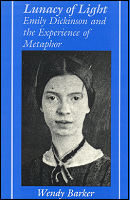
Bio: Here’s an “official” bio much longer than you ever wanted: My poems have appeared in Poetry, Southern Review, Gettysburg Review, Boulevard, Mid-American Review, among other journals. A poem of mine is included in Best American Poetry 2013, and two have been reprinted on www.versedaily.com, as well as in numerous print anthologies, including, I’m thrilled to say, Women Write Resistence (2013), your fabulous collection. My books of poetry include Nothing Between Us: The Berkeley Years (runner-up for the Del Sol Prize, Del Sol Press, 2009), Poems from Paradise (WordTech, 2005), Way of Whiteness (Wings Press, 2000), Let the Ice Speak (Ithaca House, 1991), and Winter Chickens (Corona Publishing Co., 1990). Chapbooks include Eve Remembers (Aark Arts, 1996), Between Frames (Pecan Grove, 2005), and Things of the Weather (Pudding House, 2009). I’ve also published a selection of poems accompanied by autobiographical essays, Poems’ Progress (Absey & Co., 2002). My translations (with Saranindranath Tagore) from the Bengali of India’s Nobel Prize-winning poet, Rabindranath Tagore: Final Poems (George Braziller, 2001), received the Sourette Diehl Fraser Award from the Texas Institute of Letters. I’m the author of Lunacy of Light: Emily Dickinson and the Experience of Metaphor (Southern Illinois University Press, 1987) as well as co-editor (with Sandra M. Gilbert) of The House is Made of Poetry: The Art of Ruth Stone (Southern Illinois University Press, 1996). Recipient of an NEA fellowship, a Rockefeller residency fellowship at Bellagio and the Mary Elinore Smith Poetry Prize from The American Scholar, I serve as poetry editor of Persimmon Tree, An Online Journal of the Arts for Women Over Sixty. My work has been translated into Hindi, Chinese, Japanese, Russian, and Bulgarian.
There are three Women Write Resistance events coming up in the next few days. If you’re in San Francisco, Los Angeles, or Lincoln, I hope to see you there. The bookstore for the Lincoln event is donating a percentage of all WWR book sales to a local women’s crisis center.
Reading of Women Write Resistance in Lincoln with Grace Bauer, Jennifer Perrine, Marianne Kunkel, and Sara Henning
7 pm, September 5, 2013
Indigo Bridge Books, 701 P Street #102
Lincoln, Nebraska 68508
My presale period for my forthcoming chapbook, Stranger Still, finished up this weekend. Thank you to all of you who ordered copies! It’s much appreciated and determines the press run at Finishing Line Press. This little book of Martians will ship October 25th, just in time for Halloween. Trick-or-treat!