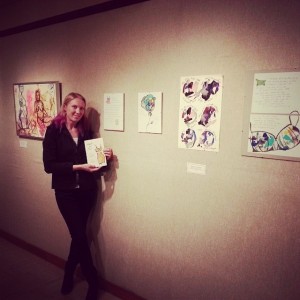
collaborative artist interview: Todd Ford on inspiration

I love collaborations. I know we both recently participated in the Art & Words Show in Texas curated by Bonnie Shufflebeam, a show that starts with a CFP for art and words. After the art is selected, the curator assigns one short story, essay, or poem to an artist and one piece of art to the writer. The artists and writers then have a few months to create something inspired by the assigned work. I enjoyed hearing all the writers and seeing all the art. It was nice to see the art and writing together. You’ve participated in other Art & Words Shows, too. What has this collaborative experience been like for you?

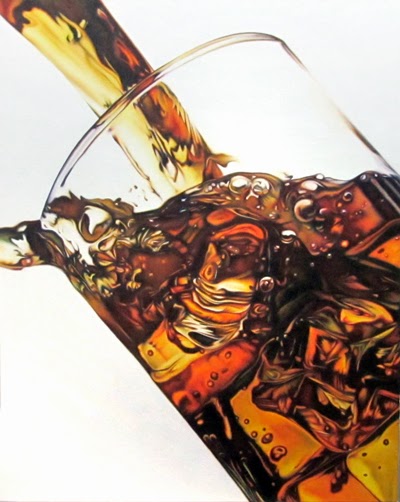
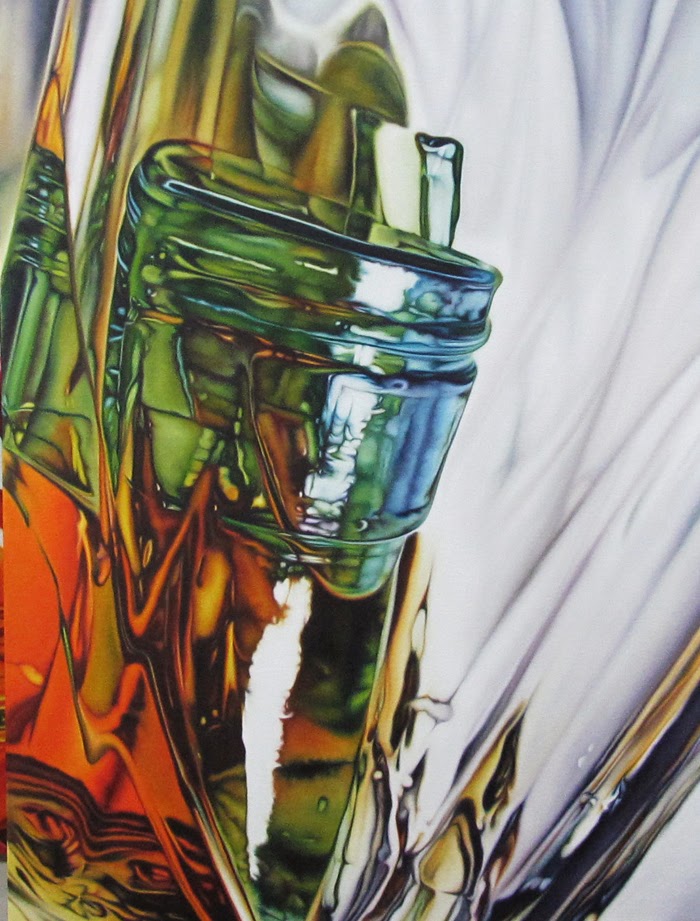
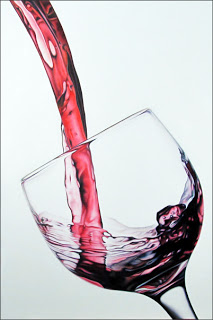
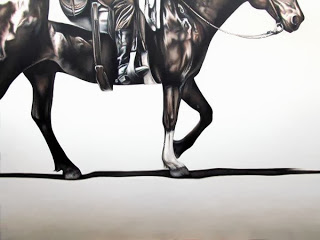
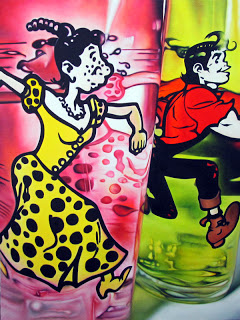
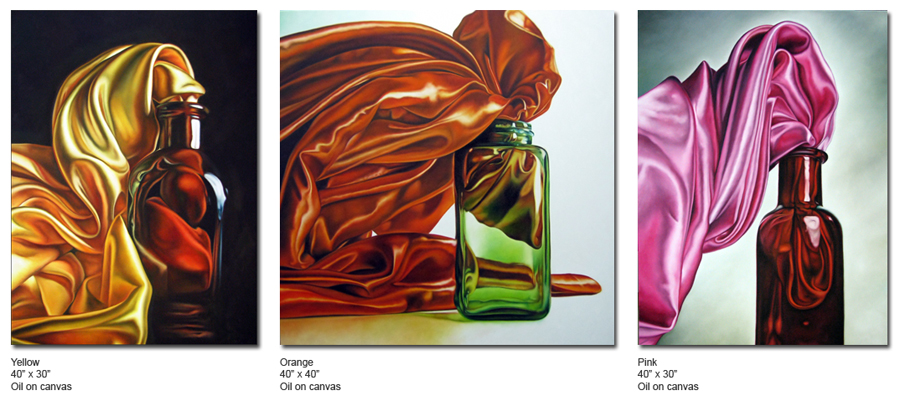
This is the second year that I have been part of the Art and Words Show. The only reason I decided to participate last year was because of the challenging nature that forced me out of my comfort zone. I enjoyed it so much that when I was invited again, I jumped on the opportunity. As an artist, I would say that I am not subject matter driven but certainly gravitate towards compositions and objects that hold visual appeal to me and fit with my aesthetic. The Art and Words show collaboration allowed, or forced, me to work in a different way. I used my sketchbook to write ideas down. I know this is not uncommon, but it is for me. Each idea seemed better than the previous, but many seemed like a good avenue to explore. When I typically start a new painting, I am 100% positive on every aspect of the future piece and my ability to realize it. Not so much on this Art and Words painting. Before I started sketching the composition on the canvas, I felt the urge to sneak up on the easel. A completely irrational approach but I wasn’t sure if the Art Gods would allow me ruin a perfectly good blank canvas with so much doubt in what I had decided to create. That point was the hardest part for me, right before I made the first mark on the canvas. Coming up with the ideas and narrowing down was challenging too, but committing to the first mark was tough. After I sketched it out and started painting though, all was fine.

A thoroughly enjoyable painting to work on and I was pleased with the outcome too. After finishing the painting, I started thinking about how it would be received by you. I knew I liked it, but I also knew that you had probably envisioned very different images when you wrote Kissing Death. I chose to create an interpretation of your piece, and not a literal “illustration”. To me, that is exciting. I am not a writer, but I have to believe that a blank canvas and a blank page hold the same possibilities. There is no right or wrong, but degrees of success. A very subjective notion, but it keeps the creative fire stoked.

Todd, I adore the painting you made. It’s so fresh and interesting. Talking to you at the Art & Words show and listening to you explain your inspiration and process was fascinating. I like the way you play with light, shadows, and the texture of glass. I thought the whole process was exciting too, especially the thrill of getting to the show, doing the reading, seeing the entire exhibition, and talking with fellow artists and writers, some from the Texas, and others from across the country. You’re currently working in Texas. What’s that like? How does it influence your art?

This will be a very boring response. Texas is a great state to live in and I really like it here. However, I would say that it does not influence my art at all.

Who were the artists you admired when you first started making art?

I was one of those kids who never lost the desire to make marks. I enjoyed art and took art classes every year at school from 6th grade until I graduated high school. During this time, there really was not one artist or group of artists who influenced me. It was all exciting and new, and I loved it all. When I started college studio and art history classes, things changed. I quickly discovered what I was exposed to in high school art only scratched the surface. I had always been able to render adequately, but it wasn’t until I discovered Photorealism that I felt a connection. I would say that Richard Estes and Ralph Goings were the two main artists who had the first big impact on me.

How do you start a new series—with a theme, an image, a question or with a material, a technique, a color? Or something else?

Good question. I consider composition to be the driving force in my art. The subject matter is not nearly as important to me as how it is presented. Sometimes, this type of visual exploration leads to a series. I do have a fascination with static and dynamic relationships in my pieces too. A vast majority of my paintings include some variation of that.

Were you ever scared to experiment in art?

No, not really. Experimentation is what led to my current style of painting. I would say that I probably experiment less these days than in the past. My limited time in the studio is dedicated to producing, so not much time to experiment.

What is inspiring you these days?

It may be somewhat narrow minded to say this, but I am sort of creating art in a bubble. I don’t hang out with other artists, regularly attend openings at galleries, or even follow artists. I do enjoy some Pop Surrealism, but that influence rarely inspires my actual work. Although on occasion, when the subject matter is “correct”, you might see a nod to Mark Ryden.

How are you trying to get better as an artist?
Every time I place a new canvas on my easel, I feel like I have an opportunity to grow. It is a literal clean slate each time, and I do not take that lightly. I strive to improve my ability to compose, see color, model, and create a painting better than the one before.

Number of art pieces you own: other than my work, about 5

Number of collaborative art pieces you own: none

Number of art pieces you admire: Too many to count.

Ways you promote and serve other artists: Links to other artists websites/blogs listed on my blog.

Ways you help initiate new collaborations: The only collaborations I have been involved with are the Art and Words show in Fort Worth (2013 and 2014). These were both very positive and challenging experiences. As far as collaborating with another visual artist, I am indifferent.

Where you spend your art earnings: Some to perpetuate the art making, some blown on indulgences, most in a saving account.

Your collaborating artist wish: No real desire, but Jackson Pollock if I had to choose.

Residence: Krum, TX

Job: High School Art Teacher and Artist

Education: B.A. Art Ed

Bio Note: I paint in a style that is similar to, but certainly not true photorealism. I am much more interested in creating work that is a synthesis of my own vision and sensibilities without the strict confinements of photorealism. I want to show a familiar object in an unfamiliar way, as something that has importance. I want the viewer to be engaged. That is my goal with every painting I create. More information available: http://fordsart.blogspot.com/ and https://www.facebook.com/pages/Todd-Ford/241748422539196?sk=wall

the chapbook interview: Sandy Marchetti on letterpress collaborations

I recently attended the Omaha Lit Fest and one of the themes I heard repeated among the panelists focused on what we include in our books as writers that work in “service to the book” or in “service to the story.” In the case of the Omaha Lit Fest with its theme of “Warped Historical In/Accuracy” panelists spoke to issues of lyrics, song titles, historical fact, and local and cultural trauma, as well as others. I’m curious about the images by Erika Adams in your chapbook A Detail in Landscape (Eating Dog Press, 2014). Can you talk about the collaborative work and how the art and words are in service to the larger chapbook?

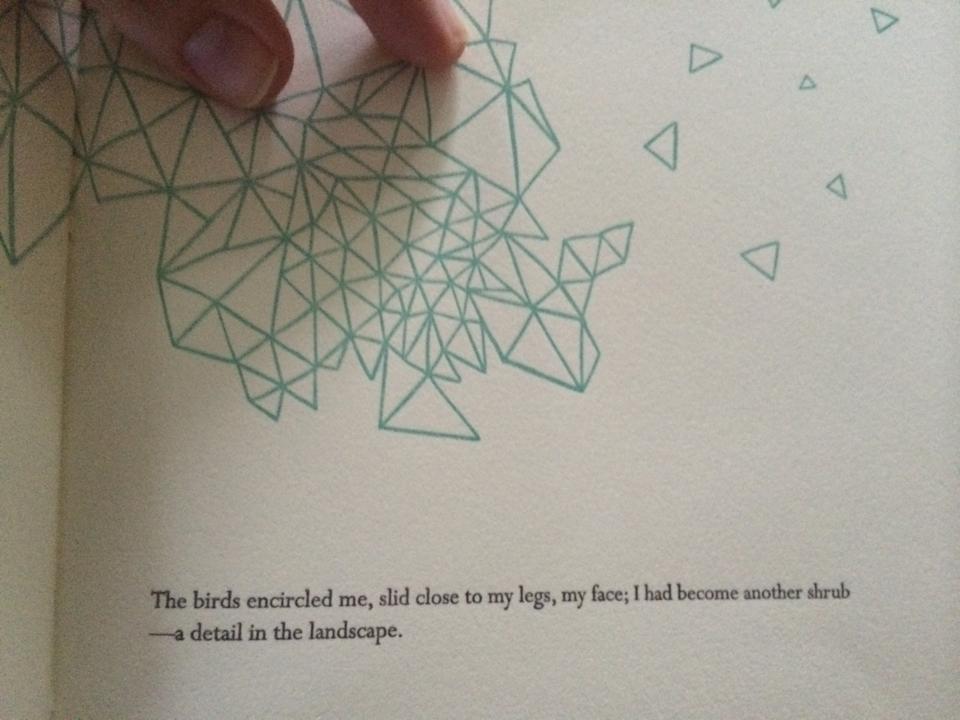
Madeline, thank you so much for inviting me to be a part of your interview series. A Detail in the Landscape is a true collaboration, so I especially identify with your query here. The sum of the visuals and words being greater than their parts was an equation Erika (founder of Eating Dog Press) and I constantly negotiated in the making of this book. We wanted to work together, after meeting at Vermont Studio Center last year, because we both knew her talent and vision as an artist and master printer could challenge and bloom my words. This is why we decided, early on, to give each other freedom to create our own “sides” of the book-hers the visual, and mine the written. We did give each other suggestions, though. For example, I mentioned a square might be the right shape for the book, and she suggested that I cut the micro-essays that accompany each poem from a paragraph down to one vibrant sentence. We trusted each other and took each others’ advice, but there wasn’t pressure to do so. Ultimately, though, this freedom enhanced the book so greatly. Erika teased out motifs in my poems beyond what I had found. For instance, Erika’s illustrations consist of abstract geometric forms made up of triangles in five colors, mostly shades of green and blue. These forms spread against the spine and could conjure the image of a flock of birds or a cloud. I would never have thought of geometric shapes as a panoramic concern of the book, but the poems really do take on a discussion of symmetry, shapes, and distances. In essence, the illustrations, shape, colors, size, and letterpress design (all executed at Erika’s hand) provide a type of critique or extrapolation of the words right inside the chapbook itself.

SM chap 1

This process that you and Erika engaged in sounds like it was lots of fun, while also inspiring and motivating—the types of projects all of us need in our lives—not to mention producing a beautiful letterpress book. At the Omaha Lit Fest at one point the director and founder, Timothy Schaffert said, “I always tell my students the difference between a published writer and an unpublished writer is the published writer finishes the book.” Were you ever scared to finish a book? Can you talk about your process of finishing your chapbook The Canopy and your forthcoming book from Sundress Publications?

Really interesting question, Madeline! That Timothy Schaffert quote is making me feel pretty good about myself! I probably should have been scared knowing what I am aware of now regarding the process of finishing a book. I was naive, as many young writers are, of the wherewithal it takes. I was lucky regarding The Canopy. At the time, in 2011, I was working on Confluence, my full-length collection that is now forthcoming with Sundress Publications. I hoped to finish it after two years of hard work. I had blinders on, and never thought of publishing a chapbook from a section of Confluence, but when I heard about the Midwest Writing Center Press contest, my interest was sparked. It was regional-only open to Midwestern poets-and I thought I might have a better chance because of that. After all of the money and time spent on rejections from Yale and the Walt Whitman Award, I took a shot. In one day, I culled a 16-page manuscript from this big book of 60 poems and sent it. I continue to pin it on sheer beginner’s luck that I won! If I had realized at the time what I know now-that a chapbook is an important publication for a poet and a great accomplishment-I might have been more anxious about sending. Really, my ignorance saved me.

After working on Confluence for a couple of years, and just after publishing The Canopy, I began to realize how difficult it was going to be to finish the full-length collection. This was incredibly frustrating, seeing as how the chapbook was picked up straightaway. I was no longer naive at this point, so instead of becoming scared this time, I got angry-more at myself than the publishers, I should note. I overhauled the book at least six times in the next three years, each time I had a crop of new work. I weeded out every lackluster poem and made sure the revisions/replacements shone. I waged a war against that manuscript, taking each poem through 80 drafts. I learned just how badly I wanted Confluence to be a book. If someone had told me it would take five years to complete the manuscript and find a publisher, I wouldn’t have believed them. I’m fairly confident about my work, but contests and publishing in general humbled me. The revision and submission process also made me a better, more tenacious poet, as it called on all of my reserves. I also met the most amazing folks along the way. I realize I have used all of these aggressive metaphors, but the vision I had for this book guided me to keep writing, revising, and sending. Even mentors told me I should move on to other projects. By the time Confluence was picked up, I knew there was nothing else I could do to make the book better. I told myself, “this book deserves to be published,” and once I really believed that, it was.

SM chap 3

I really appreciate your discussion on process for Confluence—the revision work, dedication, and the weeding out of lesser poems. It’s a process many writers go through as they revise—work that can be difficult, but necessary to make it a book. I’ve been thinking and rereading your collaborative chapbook A Detail in the Landscape. I particularly adore the last page—the last words and image of A Detail in the Landscape. Talk about endings. How do you decide where to end a chapbook, a book, a poem?

Great question! I knew I wanted to end Detail on “Never-Ending Birds” because it is the poem that begins my full-length collection, Confluence. In fact, all five lineated poems in Detail appear in Confluence, though the five prose pieces do not. I originally wanted “Birds” near the end of my full-length, but settled on it as the opening poem in service to the manuscript as a whole. A wish of mine was to have this poem end some project, and Detail felt appropriate. Hopefully “Never-Ending Birds” will lead readers out into the landscape appropriately, as the poem moves from ground-, to eye-, to sky-level. When I wrote the prose fragment for “Birds,” much later than when I wrote the lineated piece, I wanted to reflect on the process of writing the poem itself. I actually did go out and stand in a field of swallows at a local arboretum to draft “Never-Ending Birds,” so I tried to write about that process. I settled on the line, “The birds encircled me, slid close to my legs, my face,” to begin and then realized that the title of the project, “a detail in the landscape” provided a natural metric chime with “my legs, my face.” The final line now reads, “The birds encircled me, slid close to my legs, my face; I had become another shrub-a detail in the landscape.” My words surprised me. As Yeats says, this poem “clicked shut” to my ear, and that’s how I knew it was “done.”

SM chap 4

There’s a tension created with the longer poems and one the one line poems and essays in A Detail in the Landscape. It adds breath and space to the work, while also giving the reader a moment to meditate on the imagery and art. What collaborative work do you admire and what inspired you and your collaborator to structure the chapbook as you have?

Madeline, I appreciate the fact that you picked up on the “breath and space” of the book! That’s exactly what Erika and I were attempting to create. I wanted the book to be square and work diagonally-this book is about angles in so many ways-and I knew some of my shorter lineated poems would leave white space at the bottom of the lefthand pages (“By Degrees” is a good example). I thought that a poem at the top left of each left page and at the bottom right of each right page would stretch the reader visually. Both of us envisioned the illustrations as spread against the spine of the book. We thought this would allow us and the readers to use all of the page without the book appearing cluttered.

I had a chance to look at Erika’s other collections, namely Pickles I Have Known and her collaborative book Wood with poems by Brooks Wright, which helped me to envision the aesthetic of Eating Dog Press not as a publishing house but as a producer of visual art with text. I thought seriously about the collaboration we were entering into with our landscape and environment while making this book. I went out into the woods and the rivers to write these poems and Erika trekked from Montreal to Georgia to Minnesota to make the books. We met in Vermont where the idea was born, and the project took shape over the course of a full year, or four seasons. So, the collaboration that was most inspirational to me was the one we had with the land while making this object.

SM chap 2

How do you define chapbook? A chapbook to me is a poetry book I can read and enjoy in one sitting. In essence, it’s a digestible bite of poetry (or maybe prose as well!).

How are you trying to get better as a poet? I found that once I started mining and honing the voice that I used in my two chapbooks and the bigger full-length book project they came from, Confluence, that it became more difficult for me to try new things. Perhaps this was because I found a modicum of success with these projects. This risk-adverseness dovetailed with my MFA graduation. Although I’ve never been a poet who needs deadlines to write, I often need to be prodded to read new works or experiment a bit, and the MFA often helped me to do this. It’s been tough, but right now I’m attempting to become a bit less perfectionistic with my poems and explore a rawer, more ragged edge in my images. I’m trying to resist my need to totally control my poems before I send them out into the world, I suppose.

What makes a good chapbook? Any chapbook I can read in a sitting that teaches me something about the world that seems true and/or new to me.

Your chapbook credo: Do it with less. Make it count. I want epiphany.

Number of chapbooks you own: Hundreds! They are beautiful and addictive, right? Current favorites include Lucy Biederman’s The Other World, Alessandra Bava’s They Talk About Death, Lynn Emmanuel’s The Technology of Love, Nancy Kuhl’s In the Arbor, and many chapbooks from dancing girl press, Midwest Writing Center Press, Sundress Publications, Hyacinth Girl Press, and of course, Eating Dog Press!

Ways you promote and serve other chapbook poets: I do write chapbook reviews, most recently of Alessandra Bava’s They Talk about Death and Lucy Biederman’s The Other World. Prick of the Spindle, The Bakery, Extract(s), Speaking of Marvels, and of course this interview series, Laura, are great online spaces to promote chaps!

Where you spend your chapbook earnings: Actually, combined sales of the hardcover edition, softcover edition, and letterpress broadsides of A Detail in the Landscape will fund my trip back to Vermont Studio Center for a writing residency in May of 2015. VSC is where I first met Erika Adams and we hatched the idea of this collaboration. It seems only fitting that I would return there fueled by the success of our project.

Bio: Sandra Marchetti is the author of Confluence, a debut full-length poetry collection forthcoming from Sundress Publications, and holds an MFA in Creative Writing-Poetry from George Mason University. Eating Dog Press also published an illustrated edition of her essays and poetry, A Detail in the Landscape, and her first volume,The Canopy, won Midwest Writing Center’s Mississippi Valley Chapbook Contest. Sandy won Second Prize in Prick of the Spindle’s 2014 Poetry Open and was a finalist for Gulf Coast’s Poetry Prize. Her work appears in The Journal, Subtropics, The Hollins Critic, Sugar House Review, Mid-American Review, Thrush Poetry Journal,Green Mountains Review, South Dakota Review, Phoebe, and elsewhere. She currently works as a writing teacher and freelance creative manuscript editor in her hometown of Chicago.

Where we can find your chapbook: Actually, since A Detail in the Landscape was produced in a one-time, limited edition run, the book itself, in hardcover and softcover, is completely sold out. I do still have broadsides available. If you are interested, please message me here:

https://www.facebook.com/sandywritingservices

Also, stay tuned to the above space, as I may release the virtual edition of the chap as an ebook in the near future.

Collaborate Artist Interview: Sally Deskins on the female form

IF in a show 2014

You grew up in Oregon and Nebraska. What was that like? How did it influence your desire to be an artist?

Well I lived in Oregon twice growing up, and Missouri for a few years as well. Most of my upbringing was in Omaha, perhaps twelve or so homes/apartments total. My upbringing was the foundation for myself and art, so it in fact impacts it quite a lot, in ways I really can’t even express, remember or understand. But perhaps here I can start with this fact—moving frequently—kept me on my toes, taught me to see and understand ways of living differently. I was also raised with foster children and foreign exchange students. My parents are from opposite ends of the United States, and my extended family has always been spread around the states as well, so constantly seeing different ways of living made me recognize and accept different perspectives. I’ve always been an introvert, always listening and seeing. As both of my parents are creative in their own ways, as well, I learned to define “artist” broadly. My brother was often lauded the “talented artist” growing up, drawing clever comic strips and caricatures. I actually fell into theatre and loved it, starting my own “theatre club” in elementary, which I directed for a few years. In high school my shyness took over, I didn’t even want to draw in front of people, but I enjoyed journalism, and sewing, where “coolness” or “being the best” didn’t take precedence. Maybe it was all in my head. Anyway, the actual lands of Oregon, Nebraska and Missouri, I can’t actually articulate their environmental impact on me any more than my traveling anywhere. It has been more the people and direct experiences—perhaps though, the Midwest instilled in me a strong work ethic—which, if you’ve lived anywhere else, you will then appreciate. And, there is nothing like the Oregon beach, the coolness, the breeze, the free feeling it brings and back down to earth.
Wanda and Sally

Who were the artists you admired when you first started making art?

Well, way back when I wanted to be a fashion designer, it was Anna Sui. I loved her quirky, dark designs—culturally inspired and beautiful for being edgy. When I read about Marcel Duchamp in high school art history class, I fell in love with the whole Dada art movement (or non-art, effectively). When I switched to being an art major in college, I was really inspired by Jim Dine who is considered part of the “Neo-Dada” movement, but I didn’t think technicalities. I loved his expressive line quality, his personification of robes, hearts and tools. I still do. I also admired Alice Neel, her very real and patchy portraits of her friends and family, not prettified, just existent. I’ve always loved the expressionists, too. Oskar Kokoschka was one of my favorites who played with the female body, as were Gustav Klimt, Henri Matisse. (Of course here I’m talking purely aesthetically, not of their personalities or personal lives.) Different artists impact me now more specifically, but those were the artists I looked to from the start. Quite honestly, since women are notoriously skipped over in art history books I did not learn of many women in art until I began doing the work myself! I never was a huge fan of Georgia O’Keeffe until recently (perhaps because in eighth grade my teacher had us try to draw a flower like her and I was so frustrated mine turned out to look like a pink chewed up piece of gum), or Judy Chicago even. My parents had a “Women in Art” coffee table book, and perhaps a Mary Cassatt print on the wall, growing up, but I didn’t really appreciate that until later. After undergrad and when I came back to drawing, Omaha based artist Wanda Ewing was (and continues to be) a huge inspiration for me artistically and personally (see my writing about her on Les Femmes Folles here).
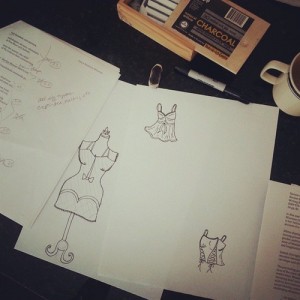
more early work with Intimates and Fools, LFF Books

How do you start a new series—with a theme, an image, a question or with a material, a technique, a color? Or something else?

With the collaborative work I’m doing with you, that starts with reading the poetry! J I suppose each series is different and depends on what is going on with my life personally, and what art supplies I have on hand. With my self-portrait series I did in college, I don’t know if I knew I was doing that. It just ended up being what I drew over and over, before I was assigned to do one. I was my natural subject since I guess I was also “finding myself” in a matter of speaking. After my hiatus and having babies, I came back drawing my babies over and over.

Yearning to get outside of baby-mode for a bit and try to almost re-find my Self and my Own Body, my next series doing body prints was another form of self-portraits. I came to this after doing some art-modeling and seeing an exhibit of Yves Klein’s “Anthopometries” series. I used my children’s finger paint and whatever paper I had, and went at it. This was also the same time I started my journal Les Femmes Folles, interviewing women in art, as I enjoyed hearing about other women’s work and their finding their way, I began to find my own. With this first series I call “Voice” (after the group exhibit I co-curated with Megan Loudon Sanders) I used some of their quotes and texted them onto my body prints to put another layer on the series. Upon the first exhibit of this series, I found more people querying about my role as mother and how my artwork might impact this, rather than the work itself. Thus was born my next series “What Will Her Kids Think?” again with body prints and text from famous and infamous women artists who are mothers about this very issue.

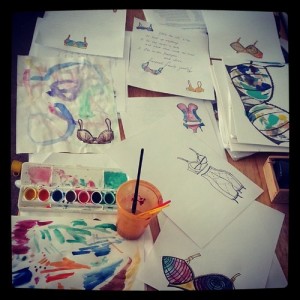
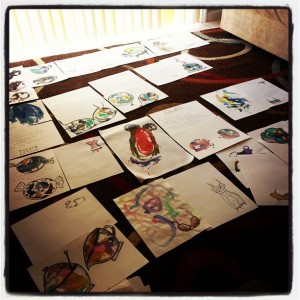
My children were growing as well. I would color and paint with them. I became interested in their very gendered imagery from their children’s books, as well as their lovely, carefree brush strokes and color choices. Again, I used what I had and began drawing figures on the many “leftover”/ “recycle-pile” pages.
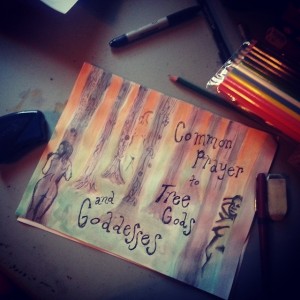
common prayer

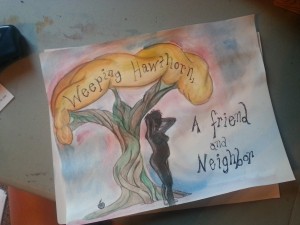
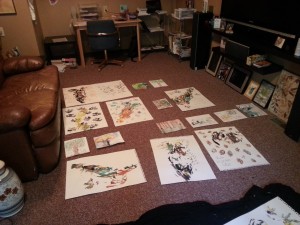
Most recently with this next collaboration with you for Leave of Absence, I began with your poetry on the topic of trees. I knew I wanted to utilize body prints but in a different way—more twisted and more abstracted parts of the body and maybe some leaf-prints as well. I knew I wanted to also incorporate some of my children’s playful imagery too. So, once again, I began with what I had—taking stock of my paper, paint, and pages from my kids’ “recycle art” pile. I found paper that would work, and laid out the colors of paint I had, and went out in the yard quick to find some interesting leaves with my kids, and just painted and printed the whole pad of 30 pages. With these and with the pile of kids’ art, I sift thru them over and over to see in them—where a figure might lie, or text, or another small illustration to add to it.

I find the “use what I have” helps me focus—as you know, Madeline, I start many works at once, leave them, start others, and keep coming back, changing, many times until they are done. So having just a certain kind of paper and media, helps me focus just a little bit, enough to get an idea formed and out into space. So I suppose, all of that having been said, a new series starts with an image (body) and then with the material.
weeping hawthorn (2)

You’re starting a masters program in art history at the University of West Virginia with a teaching assistantship, correct? How do you anticipate teaching art history will impact your work?

Tenfold. It will help me with interviews like this, at the very least—ha! As one of the professors said to me, I have all of these ideas and projects, and this will help me understand and articulate them much better. In college, I minored in art history (and English) but really only touched the surface of what I’d really like to dig into—women in art, feminist art movements, modern art, art about the body—and how they did it all (theory/methodology). I am so excited (and nervous!) to dig into the books and inner workings of artists I have never uncovered before, to seek more inspirations and find new ideas and hopefully share them with others as well—continuing the spirit of Les Femmes Folles in a bigger, broader way.
even more early work with Intimates and Fools, LFF Books

How does motherhood inspire your work? Do you create art with your children? What’s that like?

Inevitably. I am so fortunate to have healthy, happy, supportive kids and husband, and I am still alive. I am so lucky to be able to practice my art while being a mother. It helps me make and create by not having time. It makes me appreciate it when I do. It brings me down to earth and around it—further enhancing my understanding and empathy for humanity, I’d like to think (most of the time). It makes me think of the future (with this next series about environment for instance), and stick to the present (process).

Yes, I create art with them, most of it just playful and process-oriented, but sometimes something comes of it, as I discussed above. Basically, it’s on the fly; what should we paint on today? Yesterday we found some rocks to paint on, the other day they painted on every one of their toy trucks and cars and examined each of their tire tracks. Sometimes it’s just coloring books or a piece of scrap paper in my purse. At the park, my daughter likes to gather things and create “sculptures” out of sticks, rocks, leaves, whatever she finds. Sometimes I’ll get out some toys in the corner of my studio so I can get a few things done, or let them work with my pastels on the floor. It works for a few minutes but mostly they like to see what I’m doing!

I am so thankful to be able to practice my art, do what I love, and see it from their point of view. These crazy little monkeys. Too, I hope they see part of what I do intrinsically in a feminist fashion—appreciating and accepting femininity and the female form, and me being a strong (when I can) woman doing what she loves. I recently read this quote by Maya Angelou: “I would like to be known as an intelligent woman, a courageous woman, a loving woman, a woman who teaches by being.” Says it perfectly; I think of this while I work and aspire to it. So yes, motherhood is a constant. It would be hard to separate these living beings I am literally a part of, and am responsible for their well-being’s.
layout in progress

Were you ever scared to experiment in art?

Oh yes, definitely. In college, I only used charcoal for the longest time, as I was afraid color would ruin my work. I would draw and erase for hours the same line with charcoal. Then when a professor “insisted”, I would only use 1-2 colors per piece. Then in another class, we “had” to use our whole palette, and mine turned into a mess, and after that I think I just sort of let it go. That is perhaps why I love the body prints, they’re just (mostly) uncontrolled expressions in paint. I still get that hesitation with drawing though, each stage I get worried I’m going to ruin it if I go further. I still love black and lots of white. With pencil I let it all out, as I love erasing and seeing the lines underneath. But it’s different with pen and paint (when I’m hand painting). Usually when I’m drawing with pen or paintbrush in hand, I just have to take a deep breath and pull it out.
early page layouts, LFF books

What do you think is at stake when people make art that challenges notions about the female form?

Everything and nothing. This is such a big question! Women have been utilizing the female form for eons but only recently (within past 50-60 years) has their work been brought to light (and still not very brightened light). I get asked “why don’t you use the male form in your work?” and right now, I just am not drawn to create work about the male form (but actually perhaps in the near future)—but maybe that is because I have seen so many nude females in art history, the subject is ingrained in us. Maybe, on this same note, I have seen so many nude females depicted in art history by male artists, I want to contribute alongside other women artists, to show our own perspective of our own bodies. Art plays a major role in history and defining and describing our culture, and also by challenging current and past conventions. Thankfully, artists like Lorna Simpson, Judy Chicago, Ana Mendieta, Carolee Schneeman, Yoko Ono, Marina Abramovic, Hanna Wilke, Michalene Thomas and Wanda Ewing have used the nude female form to take on issues of identity, race, sex and class. With all of the negative imagery of the female form in media, add-to, the quieted and cloaked-over women-defined female form, alternative views are necessary to create a feminist, accepting world for women—as we are women by our bodies first.
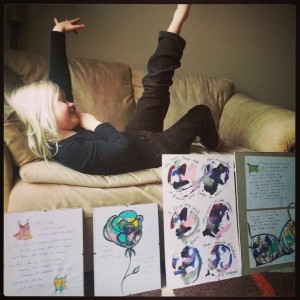
framed pages of Intimates and Fools for Ohio show 2013

With two young children, is it difficult to balance family life with making art?

Oh sure, “how do we do it all?” or whatever. There isn’t really “balance” just being and doing. Sometimes I get obsessed with a project or idea and I can’t focus when I’m present with the kids. Sometimes when I’m blocked artistically I’ll endlessly sit at my studio table looking at pictures of my kids or just play with them in the studio. But I figure, if at least I get one line drawn, one paragraph written or chapter read, I did something. And I try to make moments count with family, as well, sometimes blending the two. Everyone has to balance so we all make those choices, I suppose, though it is different when other’s lives’ are at stake, whether children, elderly or other loved ones. Again, thankfully I have healthy and supportive children and husband. Still, at times, it can be a guilt-game, either way.
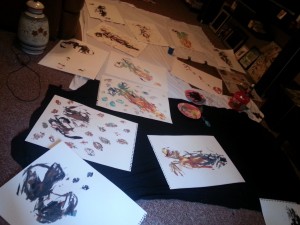
experiment with leaves

What is inspiring you these days?

Along with your poetry for this upcoming project, fresh air. Though I don’t think about living in Nebraska necessarily impacting me thru its plains, living in West Virginia seems to thru its hills. When I was growing up, I dreamed of being a fashion designer living in New York with a flat and a garden on the roof. I never thought I’d be living on two acres in the hills of West Virginia with two children and a husband J. But now that I’m here I feel it suits me—I’m a bit rough, gritty (not to mention of course I love my family), and the hills constantly remind me of how small I am in the world. Really, I am still alive; why is that? Why am I so lucky? I am thinking; what artwork am I really supposed to be creating, what projects am I meant to be doing? I look at the trees and breathe in each moment, my kids learning to ride bikes, my husband painting the house, pause, and wonder.

How are you trying to get better as an artist?

Going to graduate school, for one. Visiting art shows, reading about and interviewing other artists, listening to people’s critiques (getting reviewed!) and I suppose, just keeping at it!

Number of art pieces you own: I have no idea! Maybe 20-30 (this does not count my own, and does count small pieces).

Number of art pieces you admire: ? Infinite!
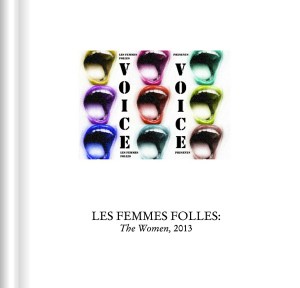
lff2013
Ways you promote and serve other artists: All right let’s toot my own horn some more! My journal, of course, Les Femmes Folles, promotes artists of all genre/media (poets, performers, activitsts however you define) and the Les Femmes Folles Books promotes writers and artists via the anthologies, and the series of collaborative books that begun with our collaboration, Intimates and Fools (stay tuned for more!). I curate exhibits, readings and other events. I write reviews and articles for other publications of visual art exhibits, projects and news, and book reviews, exclusively (as of late) art and books by women. I’m constantly pitching story ideas to new publications about art and writing by women. I would like to do more though.

Where you spend your art earnings: That’s a laugh, isn’t it. The money is already spent on its frame! Any art earnings are spent on the gas to get to the gallery, or future art supplies, or lunch for the family, or a cocktail afterwards. As for LFF Books, I do donate a portion of the proceeds to the University of Nebraska-Omaha Wanda Ewing Scholarship Fund, to honor my late friend, mentor, stellar artist and inspiration behind Les Femmes Folles. (Donate at nufoundation.org.)

Your artist wish: Just one? Ha. I don’t know, perhaps that art would be more of a mainstream thing like football—then we can really make a difference—I guess on top of that, that women’s perspectives seen through the art with which is on the front page regularly, would make a major difference with respect to women (and thus men) in everyday life. Could you imagine (most) people reading about (and thus perhaps appreciating/taking part in) non-violent expression every day? Dreamworld.

Residence: West Virginia

Job: Artist, Editor, Writer

Education: BA, University Nebraska-Lincoln; MPA, University Nebraska-Omaha

Bio: Sally Deskins is an artist, writer, mother, wife and feminist enthusiast. She is a Teaching Assistant in the Art History Graduate Program at West Virginia University. Deskins’ art explores womanhood, motherhood and the body via body-prints, drawing and text from her life and others’. Her work has been exhibited in Omaha, New York, Philadelphia, Charleston, Pittsburgh, Ohio and Chicago; and published in Certain Circuits, Weave Magazine, and Painters & Poets. She has curated exhibitions, readings and performances centered on women’s perspective and the body. Her writing has been published internationally. She is founding editor of LES FEMMES FOLLES an organization supporting women in art. She has published three LES FEMMES FOLLES anthologies of art and writing. Her first illustrated book Intimates & Fools, with poetry by Laura Madeline Wiseman, was published in 2014 by Les Femmes Folles Books. She is currently working on her second collaborative book, Leave of Absence: An Illustrated Guide to Common Garden Affection. She is also currently exhibiting in a group show at Taylor Books’ Annex Gallery in Charleston thru July 31; and will be exhibiting a solo exhibit at Future Tenant Gallery in Pittsburgh in August.
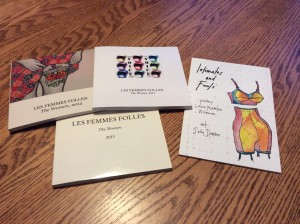
LFFB