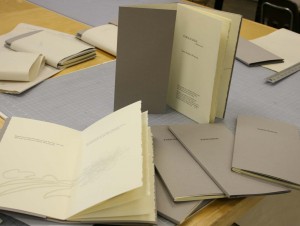
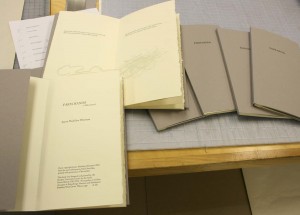
My chapbookFarm Handswas just released in a limited edition from Gold Quoin Press.
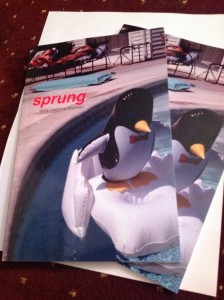
My full-length collection of poetry Sprung has just been released by San Francisco Bay Press. An excerpt of my book Sprung is in Extract(s).
Finally, check out the amazing art by Megan Sanders for the cover of my forthcoming chapbook FIRST WIFE.
In reading and performance news, my poem “Ms. Behaving,” will be performed in Lit Undressed: Women in Disguise / Omaha Lit Fest at the House of Loom, 1012 S. 10th Street, Omaha, NE, at 8 p.m., on October 24, 2012. And Monday, if you’re looking for some great readers, join me in 100 Thousand Poets for Change, hosted by Grace Bauer & Rex Walton, 7 p.m., October 1, 2012 at Crescent Moon, 140 N 8th St #10, Lincoln, Nebraska 68508. Other readers will be Jeff Alessandrelli, Grace Bauer, J V Brummels, Sarah Chavez, Crystal Gibbins, Neil Harrison, Kelly Madigan, and Rex Walton.
I just got word that my chapbook FARM HANDS created in a limited edition press run by the fine arts press Gold Quoin Press has been released. Yay! How delightful is that?
I’m still working on setting the book page up for FARM HANDS, but if you want to check it out, go here. Earlier this year, I gave a reading from FARM HANDS.
The poem “Farm Hands” responds to the research I did on an ancestor of mine, Lucile Swayzee Wiseman. When I was a writer-in-residence at the Prarie Center of the Arts in 2011, a distant cousin generously shared her family tree work and the photos she’d collected from the Wiseman line. I was most surprised to learn that many of ancestors were farmers in Iowa, Ohio, and Indiana in the 1800s. I grew up in the city, the Midwest city, but the city no less, and I’ve grown up (as an adult) in love with gardening and growing my own fruits and veggies organically. I don’t know what skips down the bloodline, but I do think my “green thumb” is directly related to all the farmhands that came before me.
The first Tuesday of the month, I gave a reading with the talented and hysterically funny Grace Bauer at Tuesdays with Writers here in Lincoln. Grace read from her essay on buying a tombstone with her family for the family plot. It was full of wonderfully wicked puns and side-cracks, and meditations on naming, poetry, the poet’s persona, and death.
I read from my chapbook SHE WHO LOVES HER FATHER that was released this summer by Dancing Girl Press,
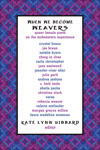
I have a poem in the current issue of Roar and Paddlefish, and in the anthologies From Glory to Glory (Poetry in the Cathedral, 2012) and When We Become Weavers (Hand Type Press, 2012). The latter isn’t technically available until October.
I also have poems forthcoming in The Raintown Review and California Quarterly and the anthologies Mercury Retrograde (Kattywompus Press) and Beverage Anthology (Pirene’s Fountain). And, I just submitted my essay “Shaking the Magic 8 Ball: Social Media for Readers and Writers” for the anthology Technology in the Literature Class: Assignments and Materials (Bedford/St. Martins, 2013).
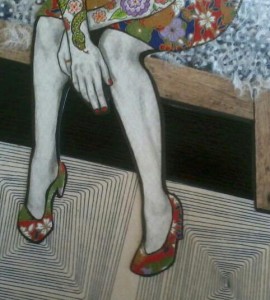
My chapbook FIRST WIFEwas accepted by Hyacinth Girl Press for the 2013 line up. I’m so excited about this! Check out my interview with HGP’s editor Margaret Brashaar. As a little sneak peak, the wonderful artist Megan Sanders is doing the cover. Here’s a sample of her work:
If you’re back in town Tuesday night, I’m reading with Grace Bauer at Tuesday with Writers.
Reading (poetry) with Grace Bauer at Tuesdays with Writers
7 p.m., September 4, 2012
South Mill, 48th & Prescott, Lincoln, Nebraska
Hope to see you there!
Finally, my poem “Ms. Behaving” has been accepted by Lit Undressed.
I like starting with the explanation that it is abbreviated for “chapter book”, so it is like a floating chapter of a larger project. However, as a genre, they’ve really taken on a strong aesthetic and cultural identity of their own. As designed objects, there’s so much freedom that the publisher has with materials, colors, cover design, binding and size. Also, I think that poetry can be easier and even more appropriate to handle in smaller doses, so it’s great to have these shorter-format books of poetry out there. Lastly, concept-wise, if you consider this shorter project as a whole, it can become a little, focused, complete entity out there in the literary world, which I think can make a really strong statement.
Many of your poems are prose poems. How would you define the form of “prose poem”?
This has come up a lot lately. I never really endeavored to study or write “prose poems” as separate from “regular poems” and am a little thrown by this distinction. Some of my poems just don’t have line breaks in them and, instead, rely on the sentence rather than the line as one of the components of its structural meaning (along with “stanza” or shape). That right there could be the main different between poems and prose poems. Line break versus sentence. For me as a contemporary writer, this doesn’t seem like enough of a major difference to create a whole separate category that would remain a valuable distinction. For instance, poets who use a lot of imagery are no longer called “imagists”… I think that line break is just one of many poetic choices that a writer can make. Or not.
For you, what makes the project of a chapbook different than the project of a book?
I don’t start off with the idea that a certain group of poems is going to be a chapbook. Most of my poems are longer pieces, and a few (Ice in Intervals, Facts of Light and Inventory) have been turned into chapbooks. Let Her was a bit different. I looked for poems that all conformed, even if somewhat loosely, to themes surrounding gender specifically for dancing girl because of their mission statement. I had been writing about gender for a few years, so it was a great way to look back on that period and then collect those pieces for a shorter, concise publication. So, the project of submitting work to be published as a chapbook can be based on grouping poems according to theme, or submitting a longer work that can be read as a cohesive whole, and makes sense as a bounded object.
Why do you think “books” are given more weight, in some circles, than chapbooks?
Well, it can be a lot harder to get a full-length collection selected and published because of the costs, press runs and process of selection of a larger press. There are various levels of status that are recognized in the poetry world, and perhaps these also coincide with the size of the readership that is made possible by having a full-length collection selected and published by an established press. I think that chapbooks are in a different category. I think that they often function more as art objects because of the smaller run and the freedom of design. However, status aside, I love the fact that people might pick up a chapbook and not have all of that weight attached to it when they encounter and read it. Hopefully it can be a lighter, fun and sincerely enjoyable experience to read the work.
You’re the author of four chapbooks. Can you tell me a little about each?
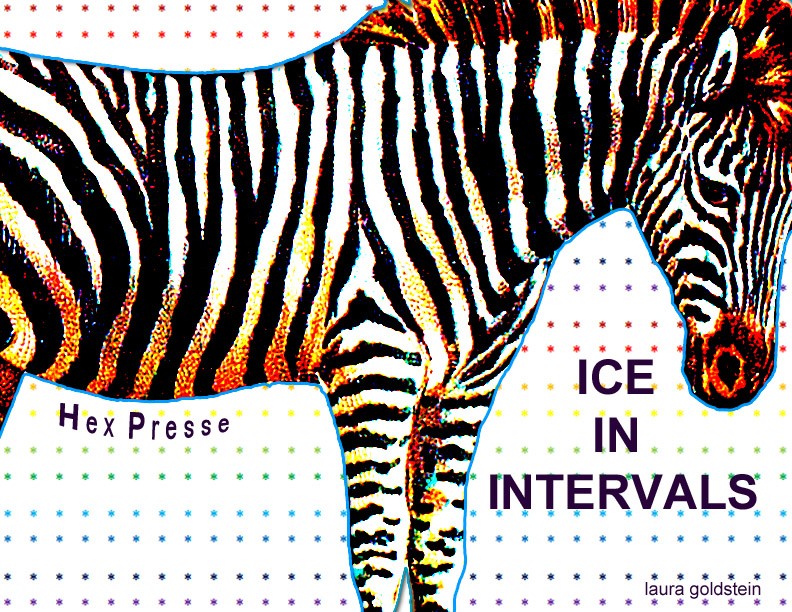
My first chapbook, Ice In Intervals, (no longer in print) has a zebra on the cover and asterisks in rainbow colors. This was a design choice made by the publisher, Michelle Detorie of Hex Presse, because of my use of asterisks to create boundaries between the individual sections and the rest of the page. Each section occupies a different space on the page, and the asterisks are meant to emphasize the white space because I was very interested in how the page might represent a unique “moment”in the brain and the stark contrast between an idea and then the white noise of total consciousness. The zebra is sort of a deceptive non-sequitur in the poem. I was so happy that Michelle wanted to put a zebra on the cover. The black and white animal contrasts well with the multi-colored punctuation.
My second chapbook was a “micro-chapbook” (available) published by Drew Kunz of Tir Auz Pigeons. I loved the idea of a 3-page chapbook and submitted a strange little 3-page poem that I wrote. I enlisted my friend, poet Amira Hanafi, to design the cover. She’s really an amazing visual poet and makes these great designs with words. She made this kind of word map of one section of the poem. Since that piece (and I am in general) was influenced by Gertrude Stein, the parsing and mapping of the sentence was a great indication of the project within.
My third chapbook was Facts of Light, which was published by Edwin R. Perry who runs Plumberries Press. He makes absolutely gorgeous books, and every one is different. Facts of Light (no longer in print) is only ten pages long, so he had visual poet and designer Melissa Dunkelberger create these truly amazing images that consisted of pieces of an apple and geometric shapes that created an ongoing, shifting record of light and dark arrangements. I think that it creates a really interesting discussion with and commentary on the piece itself, which consists of individual lines of rotating themes throughout the book.
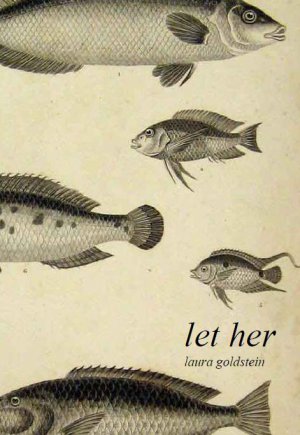
M fourth Chapbook is Let Her (available). Again, I was so thrilled to have Kristy Bowen of dancing girl press accept the work and then read it really carefully to make a decision about the cover. The poem Sisters is about my relationship with my sisters, especially when they were both going through their first pregnancies and my confusion about the boundaries between us, because we are so close, and the boundary between human beings when you are pregnant. I had a strange dream about a fish (it’s in the poem) and then the theme of fish and water and how water creates connections between things became really important in the poem. The poem became the centerpiece of the book. Kristy picked up on the idea of fish and the cover has all of these different fish swimming in different directions. I think that it says a lot about what is going on inside.
Ok, so I have FIVE chapbooks now- my chapbook Inventory(was available by subscription only) was just released by Sona Books, which is run by Jill Magi. That was a full-length project, clocking in at 26 pages, because it was initially inspired by the structure of the alphabet. Jill actually really helped me with the editing process of that poem and we worked really closely on the design. She asked me to write out the list of words that I had started with when first beginning the project about 7 years ago and printed it in my handwriting across the cover. For a much more detailed explanation about that project, please read my statement about it on her blog.
Some poets, myself included (e.g. Julia Cohen, J. Hope Stein, Grace Bauer, Kristy Bowen, Cati Porter, etc.) have several (three or more) chapbooks published before they have a book accepted. Some chapbook poets are so prolific! Given that you too are a prolific chapbook poet, what’s that about for you? What is it about your work that lends itself better to the chapbook form?
I think that the cohesive nature of my poems as longer projects definitely lends itself to the chapbook form in the literary/world. I sometimes worry that having several longer poems in a full-length collection might be a drawback when seeking publication, but I’m pretty confident that my particular structure and format will find a home.
The chapbook has become a distinct form in the literary world from the full-length collection. There is some crossover, like a chapbook really will represent a chapter of a later full-length book, but the longevity of the genre to this point has developed new constraints and possibilities for poets that make the requirements for each type of publication (chapbook and full-length) very different. Some poetry definitely lends itself better to the chapbook format, and I think some poets now specifically write towards producing chapbooks. For instance, with my work, the longer nature of most of my pieces (10-50 pages) make them prime material for a shorter format literary entity- they just match up really well.
I also think there’s a component of how publisher and poet find each other that works its way into the equation. Publishers, whether of full-length works or chapbooks, have different ideas of who their communities are and how they want the work they publish to reach them. Each poet may fit various publishers’ philosophies and format better than others, and some are perfectly suited for the sometimes quirkier and more artistic chapbook form.
What current projects are you working on?
I’m currently working on a full-length project (75 pages) called five, which was initially inspired by the structure of the Five Books of Moses. I’m very curious about the importance of this number as the books solidified into the canon of cultural and sacred texts. I have a theory that Moses himself is just a personification of the number five since his name in hebrew is very, very close to the hebrew word for five. So, structurally I am using the number five to direct the poems. Each poem is five pages long. Conceptually, I am interested in the period of time when Moses and the Hebrews are wandering the desert, between the past and the future, becoming a nation. I am curious about this fundamental notion that the identity of being a nation is still necessary to being organized for the best for people. What went along with establishing an identity as a nation was developing a hierarchical structure. At first, Moses, who was a very reluctant leader from the beginning, is just exhausting himself by addressing every concern that people bring to him during the day. At some point, his ex-father-in-law tells him that he needs to delegate. I think that’s an interesting moment. Family and tribal relationships are detaching to form a national structure. I also think that it is interesting that Moses is eventually not allowed to enter the promised land. He is a failed leader, and therefore another beautiful example of the paradoxes of being human that the Torah offers, perhaps the necessity of failure, a new kind of sacrifice. I’m interested in this notion of wandering and diaspora before hierarchy and settlement, and displacement rather than integration. I’m interested in the alternative power of associative thinking and constant flux. Every time I want to write a poem for this project, I choose a subject that I think might help to illustrate those ideas. However, I want the central piece of the poem to be a 25-page reading of the story of Moses in the desert with the Hebrews in association with the modern problems of our stalled hierarchical democracy.
Number of chapbooks you own: at least 50!
Number of chapbooks you’ve read: at least 50!
Ways you promote other poets: Buy their work, read it, comment on it in various places, curate for them as part of the Red Rover Series, which I co-curate with Jennifer Karmin
Where you spend your poetry earnings: snacks
Inspirations and influences: Ah! So many! From all sorts of contemporary conceptual poetry and art by famous people and friends, that is just constantly ongoing from reading more and going out to see more art that is happening in the city. I realized lately that the biggest influences on my writing style are Gertrude Stein, Harryette Mullen and Richard Brautigan. However, I am also extremely influenced by performance, installation work, and really good film. I am a big fan of the text/performance work of Caroline Bergvall as well as artists Mark Jeffery and Judd Morrissey, filmmakers Lars Von Trier and Charlie Kauffman, and video installation artists Yoni Goldstein and Meredith Zielke. Any work that considers and uses its own material conditions as part of the process and final result, not merely as a transparent vehicle for content. I really value experience in the moment and how it can change you in ways you don’t realize. I also attempt to create that kind of nebulous space on the page and by provoking the more uncanny effects of language. I write about Caroline Bergvall here, Mark and Judd’s work can be found here, I write about it here, and Yoni and Meredith’s work can be found here.
Residence: Chicago
Job and education: Full-time Instructor at Loyola University. MFA from School of the Art Institute of Chicago, MA from Temple University, BA from University of Pennsylvania
Bio: LAURA GOLDSTEIN’s poetry and essays can be found in American Letters and Commentary, kill author (August 2012), MAKE, jacket2, EAOGH, Requited, Little Red Leaves, and How2. Her chapbook Let Her was released from Dancing Girl Press earlier this year, and her newest chapbook, Inventory, was just released by Sona Books at the beginning of June. She currently co-curates the Red Rover reading series with Jennifer Karmin and teaches Writing and Literature at Loyola University.
Here’s the CFP for anyone who has poems about gender violence and violence against women:
WOMEN WRITE RESISTANCE: POETS RESIST GENDER VIOLENCE (Blue Light Press, 2013), a new anthology of American poets, seeks poetry submissions to round out the collection. The poets in this anthology intervene in the ways violence against women is perceived in American culture by deploying techniques to challenge those narratives and make alternatives visible. See description below. More information: https://www.facebook.com/WomenWriteResistancePoetsResistGenderViolence or https://www.facebook.com/events/338957122853722/
There are two ways to submit:
Submit 1-3 unpublished poems in the body of the email or as a doc to <womenwriteresistance(at)gmail.com> (replace (at) with @ in sending e-mail). This is the preferred submission.
Or: Submit 1-3 previously published poems in the body of the email or as a doc to <womenwriteresistance(at)gmail.com> (replace (at) with @ in sending e-mail). For this submission, please also include the following: 1) the title of your poem; 2) the name of the book, journal, or anthology where it originally appeared; 3) the name of the press or journal who published it; 4) the year or issue it was published. Please double check to make sure that you as the author retain the rights to this poem(s) or that it can be reprinted at no cost other than acknowledgement to the original source.
Please also include in your submission a bio (50-100 words) and a mailing address. Deadline for submissions is September 30, 2012.
Contributors include Kristin Abraham, Lucy Adkins, Lana Hetchman Ayers, Wendy Barker, Ellen Bass, Grace Bauer, Kimberly L. Becker, Laure-Anne Bosselaar, Shevaun Brannigan, Kristy Bowen, Susana H. Case, Joy Castro, Allison Hedge Coke, Sandi Day, Jehanne Dubrow, Rain C. Goméz, Megan Gannon, Judy Grahn, Nicole Hospital-Medina, Judy Juanita, Julie Kane, Susan Kelly-Dewitt, Paula Kolek, Alexis Krasilovsky, Marianne Kunkel, Lisa Lewis, Lyn Lifshin, Frannie Lindsay, Ellaraine Lockie, Alison Luterman, Marie-Elizabeth Mali, Leslie Adrienne Miller, Deborah A. Miranda, Linda McCarriston, Dawn McGuire, Sara Luise Newman, Claire Ortalda, Cati Porter, Laura Van Prooyen, Natanya Ann Pulley, Carol Quinn, Hilda Raz, Kimberly Roppolo, Lucinda Roy, Carly Sachs, Marjorie Saiser, Maureen Seaton, B. T. Shaw, Kathleen Tyler, Judith Vollmer, Davi Walders, Tana Jean Welch, Judy Wells, Rosemary Winslow, Karenne Wood, Andrena Zawinski, and many, many others.
WOMEN WRITE RESISTANCE: POETS RESIST GENDER VIOLENCE (Blue Light Press, 2013) views poetry as a transformative art. By deploying techniques to challenge narratives about violence against women and making alternatives to that violence visible, the American poets in WOMEN WRITE RESISTANCE intervene in the ways gender violence is perceived in American culture. A poem from a victim’s perspective, for example, might use explicit imagery but also show the emotional consequences often obscured when newspapers, video games, films, and television programs depict violence in superficial or sexualized ways. A poet might also critique dominant narratives, such as calling into question the perception that certain women deserved to be raped.
The introduction, which draws on the work of Tami Spry, Kimberlé Williams Crenshaw, and Chela Sandoval, frames the intellectual work behind the building of the anthology by describing how poets break silence, disrupt narratives, and use strategic anger to fight for change. Poetry of resistance distinguishes itself by a persuasive rhetoric that asks readers to act. The anthology’s stance believes poetry can compel action using both rhetoric and poetic techniques to motivate readers. In their deployment of these techniques, poets of resistance claim the power to name and talk about gender violence in and on their own terms. Indeed, these poets fight for change by revising justice and framing poetry as action.