Steel Pen Panel on Historical (Re)tell: The Writing and Craft of Telling Retellings of the Historic

2015 Steel Pen Print Flier

This weekend, I’m attended the Steel Pen Conference in Indiana. I’m really excited about speaking in the panel “Historical (Re)tell: The Writing and Craft of Telling Retellings of the Historic” with Cat Dixon, Britny Cordera Doane, Lindsay Lusby, and P. Ivan Young. Here’s the details for the event, the proposal, presenters bios, and descriptions of their anticpated readings and talks. I hope you’ll consider attending. It should be great fun.

Historical (Re)tell: The Writing and Craft of Telling Retellings of the Historical
with Cat Dixon, Britny Cordera Doane, Lindsay Lusby, Laura Madeline Wiseman, and P. Ivan Young
Indiana Writers’ Consortium’s 2015 Steel Pen Creative Writers’ Conference
9-10 am, Saturday, October 10, 2015
Radisson at Star Plaza, 800 East 81st Avenue
Merrillville, Indiana

Historical (Re)tell: The Writing and Craft of Telling Retellings of the Historic

“Tell the truth but tell it slant,” writes Emily Dickinson. This panel of poets and writers presents work that engages with the historical past by telling retelling of the historic, tales that offer what wasn’t said but should’ve been, what wasn’t written down but likely happened, whose voices speak that didn’t speak because at the time there wasn’t a platform on which for them to stand. Panelists explore the craft aspect of myths and legends retold from other voices, new perspectives, and counterintuitive stances. Accurate, inaccurate, or close, this panel of authors will explore how facts become transformed into the tales, histories, and family stories that inform how we tell our worlds. Panelists will discuss the craft of such writings and read from their work as they engage with the questions: What is the process for writing poems based on research and pre-existing texts? What kind of research is required to (re)tell a historical kinship between historical luminaries? How does a poet navigate fact and (in)accuracy when writing about the past? How does the influence of the world outside the poet hinder or enrich the truth as it is conveyed in poetry of (re)telling? What are the strategies of other contemporary writers who do similar work on the historical record? At what points can a writer depart from fact in the service of the story that wants to be (re)told?


Dixon photo

Cat Dixon

Cat Dixon is the author of Too Heavy to Carry (Stephen F. Austin University Press, 2014) and Our End Has Brought the Spring (Finishing Line Press, 2015). Her poetry and reviews have been published in Mid-American Review, Midwest Quarterly, and Sugar House Review. She volunteers with The Backwaters Press. www.catdix.com.

Cat Dixon will be speaking about her work with Eva Braun collected in her new chapbook Our End Has Brought the Spring (Finishing Line Press, 2015). She will address researching her subject, the time period, and Hitler’s reign as well as the few sources devoted to Braun’s life. She will address the question: Does the poet have the right to humanize what public opinion perceives as a monster? Dixon will also discuss her manuscript of work on Bob Levinson and her process that includes family interviews and research on hostage survival, hostages that have been released, and on her subject. Her talk will address the questions: Does the poet have the right to give voice to a man held in captivity? Should the poet contact the family of the person? Her presentation will address authors that have done similar retell work such as Alvin Greenberg, Angela Lambert, Zeina Hashem Beck, W.D. Snodgrass, and Frank Walker.


Britny Doane

Britny Doane

Britny Cordera Doane is the youngest author to have a book published in the history of the University of Nebraska at Omaha. Her poetry has been featured in UNO’s 13th Floor literary magazine, the Mythic Poetry Series by Silver Birch Press, the Women for Women international publication: Forget Me Not, and most recently in both the Fall 2014 and May 2015 Pinyon Reviews. Her maiden voyage, Wingmakers, was published by Pinyon Publishing in February 2015. Known locally as the Old Market Poet, she is often set up with her typewriter, in Omaha’s Old Market district, sharing her work with others.

Drawing from the work of Mircea Eliade, Technicians of the Sacred Edited by Jerome Rothenberg, and Joseph Brodsky, Britny Cordera Doane will discuss how mythology was used to give meaning to things that were at one time unexplainable and how writers use mythology to not only preserve the past, but also to explain the unexplainable within their own lives. Doane presentation will explore the importance of origin stories, and how every culture has a unique origin story for their myths, the connections and patterns found within mythology, cross-culturally, and intertextually, and the language of the sacred found in symbols, mythology, and poetry, to convey our everyday experiences and to connect with the mysteries of the universe. Her talk will also explore the phenomena of axis mundi within mythology and sacred traditions.


Lindsay Lusby

Lindsay Lusby

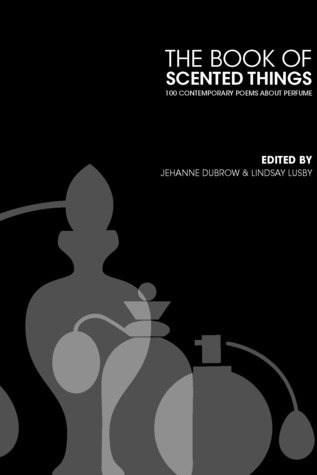
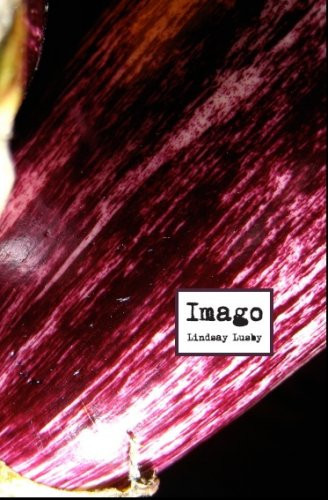
Lindsay Lusby is the author of Imago (dancing girl press, 2014). Her poetry has appeared in Sugar House Review, The Lumberyard, Fairy Tale Review, and elsewhere. She is Assistant Director of the Rose O’Neill Literary House, serving as assistant editor for Literary House Press & managing editor for Cherry Tree.

Referencing the work of contemporary (re)tell writers such as Kate Bernheimer, A.S. Byatt, Italo Calvino, Angela Carter, Neil Gaiman, and Jeanette Winterson and drawing upon her reading of the scholarly text Twice Upon a Time: Women Writers and the History of the Fairy Tale, by Elizabeth Wanning Harries, Lindsay Lusby’s talk will touch on the long tradition of (re)telling in the folk and fairy tale genre, how different versions play off one another to create new meaning through historical contrast, and how the (re)telling of fairy tales has traditionally leaned toward reframing the stories in a way that highlights the need for current social change.


laura madeline wiseman KHN

Laura Madeline Wiseman

Laura Madeline Wiseman is the author over twenty books and chapbooks and the editor of Women Write Resistance: Poets Resist Gender Violence (Hyacinth Girl Press, 2013). Her most recent book is Drink (BlazeVOX Books, 2015). She teaches creative writing, English, and women’s and gender studies in Nebraska. www.lauramadelinewiseman.com

Drawing from the work of contemporary (re)tell work such as that done by Carole Simmons Olds, Natasha Trethewey, and Margaret Atwood and the work of feminist scholars such as Elaine Scarry, Laura Madeline Wiseman will explore scholarly framework when approaching writing about family violence, the body, and girlhood as those stories challenge depictions of gendered expectations in fairy tales and myths such as those of mermaids, the wives of bluebeard, and the lady of death. Specifically, her work is interested in exploring the narrative quality of myths and troubling the plots such tales offer. Her presentation will also address researching a family ancestor and the craft of writing poems that seek to preserve a voice that might otherwise be lost from the historic record, as such work invokes the political, educational, and reformist landscape of the nineteenth century.


P. Ivan Young

Ivan Young is the author of Smell of Salt, Ghost of Rain (Brick House Books, 2015) and the chapbook A Shape in the Waves (Stepping Stones Press, 2009). He teaches Creative Writing at University of Nebraska Omaha and is Coordinator of The Center for Faculty Excellence.

Ivan Young presentation will explore classical mythology, biblical myth, and fairy tale as one method for retelling of self. His talk will build from Sir Philip Sidney’s notion of the poet as a combination of the philosopher and the historian (in the older context) and will transition into Mark Doty’s piece on the perspective box. His seeks to address the question: What are we accomplishing in retelling the past? Sidney suggests that the poet finds a greater truth in retelling, but Doty explores the possibility that we may be distorting the past. Young seeks to explore the space in between such positions, how both clarity and distortion are a way of shaping the self within the contexts of our own experience, education, and political foresight, and the ways retelling not only shapes current experience but also how it reshapes our perceptions of the past.

the chapbook interview: Lindsay Lusby on the mother-beast of a poem

Lindsay Lusby

Your work as an editor and poet gives you the opportunity to work with several different genres of publication—literary journal, anthology, broadside, letterpress—as well other venues of literary culture such as writer-residencies, salons, readings, and launches. What do you admire about the chapbook form as a genre and vessel for poems?

I don’t think there is anything else that does just what a chapbook does for presenting and shaping poems. When I began writing Imago, it was a huge experiment for me. It was the first time I ever attempted writing poems in a series, interconnected pieces that create and continue a lyric fairy-tale narrative. Although it’s almost impossible to sustain this over 40-60 poems, a length of 10-20 poems is just right—the Goldilocks quotient. These parameters also gave me the freedom to explore narrative possibilities in a way that I never had previously when my focus was on the smaller frame of the individual poem. Where one poem ended, I could pick up the lyric thread and continue to push it further. My chapbook experiment forced me to push past the mystery that I like to leave my poems suspended within. I had to find answers to the poetic questions I posed. The interconnectedness of these poems also made them very dependent upon each other for meaning and context, which meant that they lost some of their potency if presented as individual poems (say in a literary journal or anthology). This could be considered a weakness in the poems, but gathered together in their intended sequence in a chapbook, they seem to form one bigger and stronger poem. That’s what I think the chapbook does best, when it works: assembles a group of poems into one larger mother-beast of a poem.


Imago (Dancing Girl Press, 2014) is your first chapbook. What did you learn in the writing classes and workshops you took in college about the chapbook as a genre? Talk about your classroom experiences that informed your thinking about the chapbook.

Of all the creative writing workshops and classes I took as an undergrad, I don’t really recall much mention of chapbooks, sadly. There was plenty of focus on how individual poems work (and don’t work) and on analyzing full-length collections, but no chaps. My introduction to chapbooks actually came through the letterpress printing and bookbinding workshops I took during that time. So I learned about the history of chapbooks as folk art, as object. Their intersection with the publication of contemporary poetry just served to draw me in further. Because of this introduction, I will always think of chapbooks as both physical artifact/art object and vehicle for poetry.


Your chapbook Imago is a coming-of-age story of fairy tale and myth. What are the strategies you admire of other contemporary writers who do similar work in the genre? Talk about your interest in retellings.

My two favorite retellers of fairy tales and myth are Angela Carter and Kate Bernheimer. They completely embrace the inherent weirdness of fairy tales, and then they amplify that weirdness. Carter takes it to the carnivalesque and Bernheimer to dark and visceral whimsy—both nurture the tales’ grotesqueries. I think I favor Bernheimer’s approach more in my own writing; although in my reading, I love both equally. In her fabulous and insightful essay in The Volta, Kate Bernheimer called all of this the “fairy way of writing,” after Dryden. She articulates so many of the qualities of fairy tale that were previously inexplicable to me: everyday magic, intuitive logic, flatness, abstraction. These are the things that make fairy tales and myth such fun to play with and rearrange.

Link to Bernheimer essay: http://www.thevolta.org/ewc30-kbernheimer-p1.html


Writers and poets often talk about advocating for their work, promoting their work, and supporting the work of other writers by giving back, thereby creating a community where literary endeavors of small presses and the writers they publish is celebrated, discussed, and read. What strategies of advocacy and promotion do you think are most helpful for the chapbook?

I think this will always be a difficult area because the audience for chapbooks is even smaller than the audience for poetry in general. But I think the presses themselves have a great way of forming an instant sisterhood among the poets they publish, even if they haven’t met before. There’s a certain something about our writing that makes it Dancing Girl Press material, so we’re already more likely to have a natural affinity for each other’s work. And because of that, our audiences also naturally overlap a bit and every DGP poet I’ve met online or in person has been so generous about supporting my chapbook and the chaps of other DGPers, even sharing their own spotlight. I mean we are each other’s audience! It’s a connection that feels much more familial than it does competitive, so our instinct is to cheer on each other’s successes because any DGP win feels like a victory for each of us individually, too. Maybe that’s just me? But I don’t think it is. I think reading and thoughtfully reviewing each other’s chapbooks is a great strategy. Because who knows and appreciates the art of chapbooks better than we do? We are the ones who can best explain to the uninitiated what is so important and beautiful about chapbooks. Holding collaborative events—readings and salons, especially events that bring in a second medium like music, visual art, etc.—is also a fantastic way to simultaneously support and celebrate each other’s work while presenting it to an audience of potential readers. The most successful and engaging events I’ve held or attended feature a meeting of connected but separate arts media. For celebrating chapbooks, what about an event that is both a reading from chapbook poets and a demonstration of bookbinding or printing techniques? I would love to attend that!


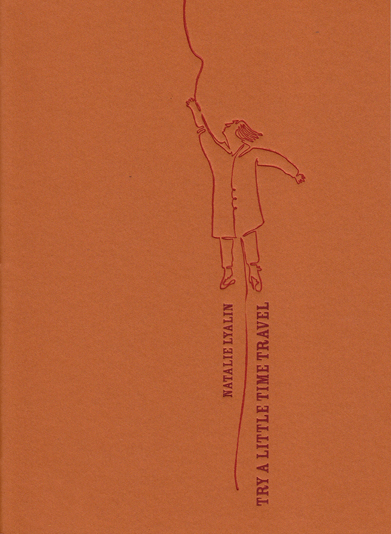
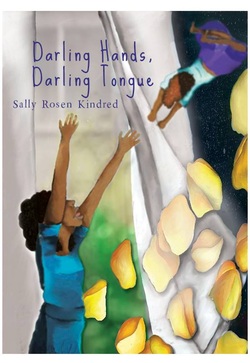
What chapbooks are inspiring you these days? Try a Little Time Travel, by Natalie Lyalin (Ugly Duckling Presse, 2010) is one of my all-time favorite chapbooks. It is perfect in its sense of play. Darling Hands, Darling Tongue, by Sally Rosen Kindred (Hyacinth Girl Press, 2013) is also a fantastic chapbook discovery of a few months ago.

What do you look for when you put together a chapbook? I look for poems that need to be alone together. Those poems that really need to get a room because they’re making the other poems around them uncomfortable with how intimate they are with each other.


What’s next for you?
I’m currently working on building my first full-length poetry collection, which I’ve called Catechesis. I’m also working on a collaborative chapbook with my poet-friend Emma Sovich, called Women’s Work. We’re both letterpress printers (she’s actually just completed her Book Arts MFA at the University of Alabama!) and proud feminists. For such an industrial art, the letterpress printing renaissance that we’re living right now is also largely populated by women (you can check out this awesome group called the Ladies of Letterpress here: www.ladiesofletterpress.com). And all of these awesome women in the print shop has us feeling like the proper granddaughters of Rosie the Riveter—at home amid the smells of lead type and rubber-based ink, working to the hum of the motorized proof or platen press. Our collaborative chapbook will attempt to use the cast-iron imagery of the print shop to create a contrast with the traditional notion of softer, domestic tasks as “women’s work.” Emma and I hope that, in the end, the fifteen to twenty poems we write for this chapbook manage to construct a kind of printers’ feminist manifesto (or even a feminists’ printing manifesto).


Current chapbook reading list: I picked up a stack of new chapbooks at AWP Minneapolis that I’m excited to begin: The Greenhouse, by Lisa Gluskin Stonestreet (Bull City Press, 2014); Beneath the Ice Fish Like Souls Look Alike, by Emilia Phillips (Bull City Press, 2015); No Girls No Telephones, by Brittany Cavallaro & Rebecca Hazelton (Black Lawrence Press, 2014); Lace & Pyrite: Letters from Two Gardens, by Ross Gay & Aimee Nezhukumatathil (Organic Weapon Arts, 2014); and Should Our Own Undoing Come Down Upon Us White, by Jill Osier (Bull City Press, 2013).

Number of chapbooks you own: 35 (I think!). At least, those are the ones I can find right now.

Number of chapbooks you’ve read: 21 (that I can remember right now!). I still have a good amount in my stack to get to reading.

Where you spend your chapbook earnings: The little I make from my chapbook goes toward the lofty goal of helping to pay down my credit card balance, which is primarily a healthy mountain of vet bills for my dog and two cats.

Residence: Chestertown, Maryland

Job: Assistant Director of the Rose O’Neill Literary House at Washington College