To Speak of Dahlias, your recent chapbook from Finishing Line Press, is a lovely mediation on making—the making of art, the body, family—and also on unmaking. Can you talk about your process of making poems, making books and chapbooks, and there by making meaning by making art?
What a lovely question! I have always considered the act of writing to stem from the body. Writing is an embodied act, fusing the head, the hands, and the heart. When I am writing, I divest myself of borders and just enter the field of language. I feel, and then I think. When I’m thinking, I’m generally on my Smartphone researching (behavior of animals, scientific variables, perjured women, issues of the psyche and its aperture). Then, I internalize my research and feel my way onto paper. The birthing of a poem in this way can vary from a week to several months, and the revision process, when I am honing, sculpting, and providing sinew, can culminate in a day or a year. I never give my poems time limits, and I never rush their publication. When the poem is ready, it will let me know.
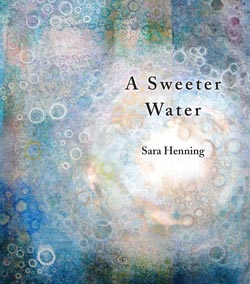
The making of books is an entirely different process. Trying to find the best combination for the poems to connect with each other, reverberate, and find fluidity is a process in which I am still seeking competency. I have relied quite a bit on my exceptional mentor, poet Lee Ann Roripaugh, for help finding an order to my work. While my poems found their own connection in To Speak of Dahlias, Lee was integral in helping A Sweeter Water to find its shape and poise. I am currently writing my second full-length collection, tentatively titled Lost Girls, and I am working with trying to listen to the poems. Sometimes, I think if I can listen closely to the poems, they can find their way to each other like lovers.

In both your chapbook To Speak of Dahlias and in your full-length collection A Sweeter Water the theme and image of the dahlia reoccurs. It’s a beautiful and complicated image. I’m wondering if you can talk about this artistic choice.
The image of the dahlia is very compelling to me, perhaps because it is complicated. First, it is a beautiful flower that underwent issues of dubious naming. It was named after two botanists—Swedish botanist Dr. Anders Dahl, from which it attained the name by which we know it today, but also by botanist Dr. Johann Georgi of Petersburg, who named the flower Georgina. The name of dahlia was only recently clarified. In both of my poetry collections, the question of naming seemed exigent to me, as one central motif of both collections draws upon the speaker’s lineage. She is not only the literal product of adultery, after which many secrets and obfuscations follow, but has an uncertain existential existence she spends the duration of the book attempting to unraveling for the reader.
Second, the dahlia is a robust plant, a source of nourishment and fertility. It was first brought from Mexico to Malmaison by Empress Josephine de Beauharnais for her garden. One must remember that in nineteenth century France, dahlias held the cultural capital of diamonds. After one of her servants stole a coveted tuber, the Empress commanded all of the plants be destroyed. Weed-like, dahlias self-reproduced after this act of extermination, and in the 1840’s became a food source after the blight of the potato crop. From this historical episode, I have come to see the flower as an image of sustainability and self-perpetuation, which seems to follow the speaker as she emerges out of dangerous confusion into a clarified existential space toward the end of both collections.
I know you’ve been to the Vermont Studio Center as a writer-in-residence. What was that experience like? How important are colonies and residencies for writers?
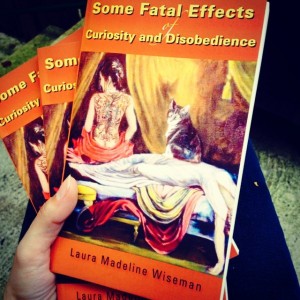
My experience at the Vermont Studio Center was an empowering one. I went in 2008 after experiencing some post-MFA artistic anorexia, and left with a feeling of vigor. I had the chance to converse with poets Mark Irwin and Fanny Howe about my poems, gleaning important and constructive feedback, and had the time and space to create lasting friendships with amazing artists and writers that have lasted until today. A very talented and warm-hearted artist I met during my residency, Leslie Joren Wagner, ended up designing my book cover!
I think colonies and residencies for writers can be important, but are not for everyone. A poet friend of mine tries to participate in a residency every summer he can because it provides him time and space away from his quotidian experience, and thus the emotional space to engage in meaningful writing. I can be a bit of a social butterfly, and so found days devoted to isolation away from my loves and cats challenging, especially as the residency reached the third week. Given this personality tic, my social interactions with the artists and writers were often more gratifying than the actual work I accomplished, but I know many who have relied on the sacred quiet of a residency writing studio to finish books and projects.
In “Consociational Poetics: An Interview with Anne Waldman” the March/April 2013 issue of The Writer’s Chronicle, Waldman talks about her “founding mothers” and the women writers “who have had the burden of neglect or struggle to be heart” (58). I’m wondering if you can talk about the women writers who have “opened the floodgates” for the writing you’ve done, are doing, and hope to do in the future?
I’d love to! Let’s be honest: I owe my artistic life to Muriel Rukeyser. Without her poetics of lived social justice, equality, and feminism, many strong female writers could not have followed in her stead. One of her mentees, Anne Sexton, even called her “mother of us all.” I admire the feminist social activist poets who followed her, poets who demanded that society be accountable for its behavior.
In his latest book, The Poet Resigns: Poetry in a Difficult World, poet and critic Robert Archambeau has described the discursive state of poetry—glutted with professionalization, smug bohemianism and a dangerously dwindling readership. In an atmosphere decimated by war, poverty and an increasing need to justify one’s weight in cultural capital, he asserts that poetry is suffering the fate of subcultural demotion and growing cultural ambivalence. That’s a pretty bold assessment, but really, what he is saying shouldn’t really be shocking. I mean, critic Charles Altieri engaged a dystopic scrutiny of contemporary poetry’s cultural moment (through its award of prizes and what is taught in MFA programs) almost thirty years ago in his 1984 work, Self and Sensibility in Contemporary American Poetry. In this work, he exposed a system of stylistics aimed at an audience made homogenous by its state of economic and social privilege. He claims that the lyricism that emerged, including restrained setting and emotion building to a predictable climactic image, was alluring because it approximated the narcissistic sensibility of the professional classes. Since then, the claim that contemporary poetry remains infested by boutique McWriters practicing shadow-dances of homogeneity for an audience of each other, or compelling writers dumbfounded into reticence by national and international horrors, seems to be an alarming, yet conventional trend.
What baffles me is that in this paradoxical environment described above is allowed to perpetuate in the wake of the aforementioned Rukeyser’s “Book of the Dead,” Adrienne Rich’s Diving Into the Wreck, Carolyn Forche’s poetry of witness, and the volumes of poetry addressing a world devastated by Vietnam, 9/11, Hurricane Katrina and the silent war on women. It is in this enigmatic environment that I’m trying to engage with poetry as a means of embodied resistance to hegemonic narratives. After all, I strongly subscribe to second-wave feminism’s axiom, the personal is political.
You grew up in Georgia and currently live in South Dakota where you are pursing your doctorate. You also travel a good deal for readings. How does place inform your poetics?
Physical place for me is less important than metaphysical and psychic place, though the two inform each other. When I am outside of a physical environment, I am able to garner a more accurate representation of it than when I am ensconced in it. This is important when the physical place I am attempting to penetrate has had important meaning for me. For instance, much of A Sweeter Water takes place in, and addresses, issues exigent to lower class Southern culture. The poems that speak to this were largely written during my first year living in South Dakota. Distance, displacement and diaspora engender a sad yet allusive safety for me, because escape can mean shearing off essential, yet comfortingly dysfunctional, elements of identity.
When I find myself in disparate cultures, I am always measuring difference between where I was and where I am going. For instance, I spent the winter holidays in New Orleans, a place that we know is both culturally enriched and ravaged by eco-critical and social issues. To relate to what I saw of the aftermath of Hurricane Katrina spliced against the exploitative tourist romps of the privileged on Bourbon Street, I thought of how my mother, living in a cockroach-infested apartment in Savannah, Georgia on a steady diet of generic cigarettes and beans and rice, boarded up her windows to escape the ravages of Hurricane David, while a short drive away, revelers indulged in alcohol-tinged escapades on River Street, and lavished in beach getaways on Tybee Island. While lately I find myself in a different place almost every month (I thank the English Department of the University of South Dakota for allowing generous funding for graduate students to participate in conferences and reading), I see the change in place as a lineage in the fold of my emotional displacement, rather than an exotic encounter.
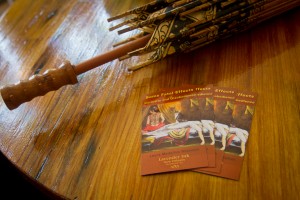
Given that you’ve just had a new book released from Lavender Ink and are giving readings to promote it, what’s the influence of performing your poems on your writing—does the anticipation of reading or giving readings influence how your work appears on the page?
Not long ago, my mother told me that though she would have preferred my choice of the medical profession over literary academia, she was nonetheless convinced during my younger years that I would end up employed as a song writer. As a girl I took piano lessons, and often would play by ear instead of performing the notes on the page. When I like a musical artist, I will often listen to his or her work on repeat in order to get the songs into my blood to better understand them. These songs stay with me for years: Irving Berlin, George and Ira Gershwin, John Lennon. The list goes on.
How does this translate to poetry? When I give readings, I find that most of my poems work better when read aloud than when read silently on the page, and that isn’t because I try to write for performativity. I think it just happens organically for me, and this comes back to the notion that writing is an embodied process for me, one that uses every single one of my physiological facilities: breath, the way the throat clenches and reopens when a sound is both beautiful and painful, the fact that the body, in pain and pleasure, performs a kind of song.
What is inspiring you these days? The polar vortex, the heart’s resiliency, how the body and mind are often so amazingly able to heal themselves.
How are you trying to get better as a poet? I read everything I can get my hands on. I am in the middle of ordering books to study for my comprehensive exams, and while this is surely a daunting process, I am pretty excited to have an excuse to bury myself in books. I also try to write regularly, though this can be hard while pursuing doctoral study. I also try to forgive myself the time it takes me to engage in the creative process. Much of this time can be perceived by others as “down time”: surfing the internet and researching minutiae, meditating under a pillow, watching my cat perform his territorial shenanigans, long interludes of staring into space. I am trying to remind myself that this is all necessary time, even when it feels like a poem should just sashay right out of me when I put pen to paper, already muscular and seductive, ready to be cossetted onto the page.
Your chapbook credo: The heart burns harder than anything, so why not focus on the heart of anything? The poems of a chapbook are like incantatory distillations, their own, short and intense experience. Being able to achieve this brand of tight fluidity is an amazing practice, and I recommend it to anyone who hasn’t tried it.
Number of chapbooks you own: probably 30
Number of chapbooks you’ve read: probably 20
Ways you promote and serve other chapbook poets: When my friends publish chapbooks, I like to include them on my social media outlets. As money allows, I try to buy as many chapbooks as I can. I also make myself available to write blurbs, which is an intensely pleasurable experience for me.
Where you spend your chapbook earnings: On things essential to preserving the literary life: groceries, cat food, books, essential oil, and my subscription to Dropbox.
Your chapbook wish: I would love to write another chapbook! They feel essential to book writing for me, a way to experience the architecture of a longer work.
Residence: This city girl now lives in a little house on the prairie in Vermillion, South Dakota.
Job: I am employed as a graduate teaching assistant at the University of South Dakota, where I also serve as the Managing Editor of the South Dakota Review. During the summer months, I read exams for the AP Literature program, and attempt to gain employment as an adjunct for my university. I also serve as a short order cook for my Muse, who has most recently been discovered attending twelve-step meetings for a pretty crippling addiction to beignets.
Chapbook education: About four years ago, I watched an ex-boyfriend who was also a poet compile a chapbook. As I watched him go through the process, another close friend shared with me her method of compiling, and publishing, a chapbook with Finishing Line Press. Incidentally, this press that would later become my chapbook press.
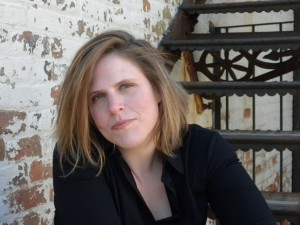
Chapbook Bio: Sara Henning is the author of A Sweeter Water (Lavender Ink, 2013), as well as a chapbook, To Speak of Dahlias (Finishing Line Press, 2012). Her poetry, fiction, interviews and book reviews have appeared or are forthcoming in such journals as Willow Springs, Bombay Gin and the Crab Orchard Review. Currently a doctoral student in English and Creative Writing at the University of South Dakota, she serves as Managing Editor for The South Dakota Review.